MittiTech is an independent, India-first guide to emerging agricultural technology. We examine what artificial intelligence, farm drones, digital public infrastructure and decision tools can actually do under Indian field conditions—before a farmer, buyer or policymaker treats a headline, demonstration or pilot result as proof.
Our guides connect official programme data, institutional research and real implementation constraints. We separate services available today from technologies that are still being tested, distinguish laboratory accuracy from field reliability, and make costs, access routes, limitations and safety questions explicit. The objective is practical judgment—not technology promotion.
Use the pathways below to evaluate a purchase or service, understand a government programme, or test whether an AI claim is likely to hold up on an Indian farm.
Start with the decision you need to make
Evaluate farm tools and services
- What a drone-spraying service costs per acre—and when ownership makes little sense
- Which agriculture drone camera is useful, excessive or premature for an Indian farm
- What AI irrigation scheduling needs before its recommendation can be trusted
Understand subsidies and public systems
- Who actually receives India’s agriculture drone subsidies and what remains out of pocket
- What AgriStack’s Farmer IDs have delivered—and what the headline numbers do not prove
- How PMFBY’s YES-TECH, CROPIC and WhatsApp processes affect a farmer’s claim
Test AI claims against field reality
- Why crop-disease app accuracy falls between a laboratory test and a real field
- Whose data an AI yield model learns from—and why that matters for a small plot
- Which pest and weather alerts work today and which remain pilot-stage
How MittiTech evaluates a claim
- India first: local farm sizes, costs, infrastructure and access matter more than imported demonstrations.
- Evidence before excitement: official and institutional sources are linked, and missing evidence is stated plainly.
- Decision usefulness: each guide explains what the evidence changes for a farmer, service buyer or programme stakeholder.
- Safety and uncertainty: limitations and professional-advice boundaries are made visible where a wrong decision could affect a crop or livelihood.
Latest evidence-backed guides
- Agriculture Drone Rules in India: Registration, Pilot Certificate & Spraying Permissions
 Who needs a drone pilot certificate in India? The practical UIN, airspace, pesticide and field-safety checks farmers and service providers should complete before an agricultural spray.
 - PMFBY Technology: YES-TECH, CROPIC & WhatsApp Claims
 Can PMFBY satellites decide a farmer’s claim? How YES-TECH estimates area yields, CROPIC records field damage, and the WhatsApp chatbot helps—plus the 72-hour reporting rule.
 - KVK Drone Demonstrations in India: 4.27 Lakh Farmers Reached—but What Did They Actually Get?
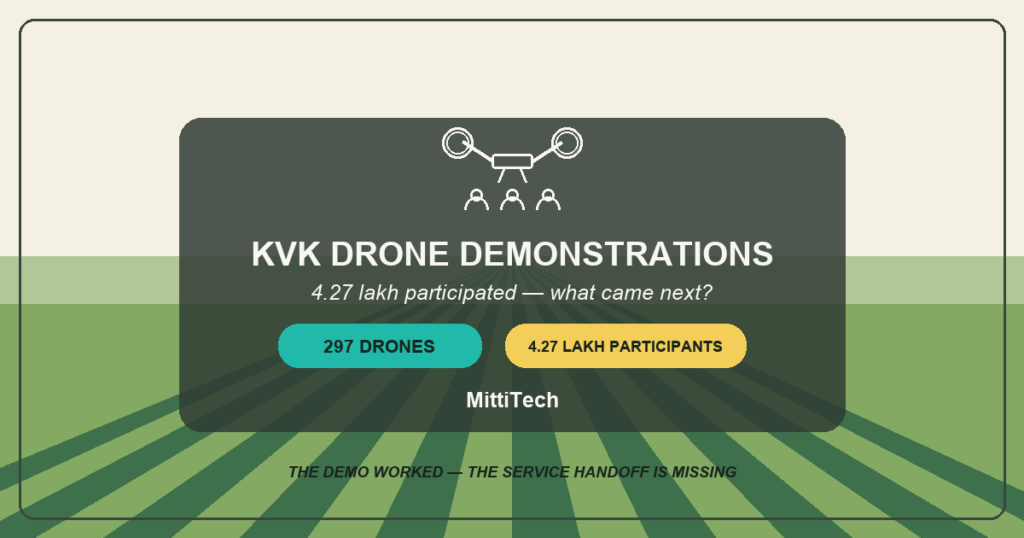 KVK drone demonstrations reached 4.27 lakh participating farmers—but the official data does not show how many later booked or repeated a local drone service.
 - AgriStack in 2026: What 9.2 Crore Farmer IDs Actually Delivered
 TL;DR — the verdict: AgriStack is no longer merely a government pilot. By March 2026, India had generated about 9.2 crore Farmer IDs, roughly… Read more: AgriStack in 2026: What 9.2 Crore Farmer IDs Actually Delivered
 - AI Irrigation Scheduling: Global Tech, India Reality
 TL;DR: AI irrigation scheduling is not a magic pump switch. The useful systems combine calibrated soil sensors, crop and weather data, and a decision… Read more: AI Irrigation Scheduling: Global Tech, India Reality
 - Drone Spraying Service in India: What Farmers Pay Per Acre
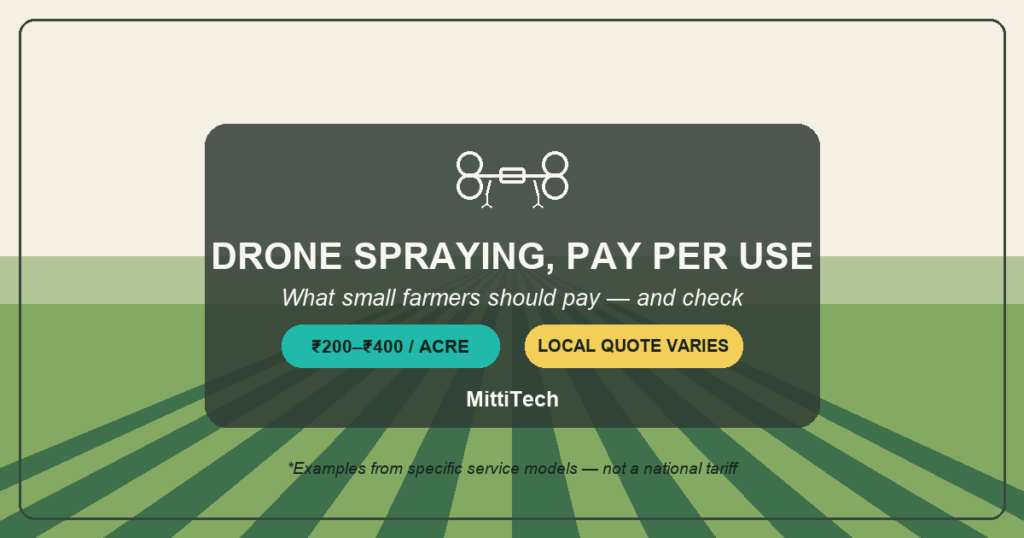 A farm drone can cost several lakh rupees, needs a trained operator, and may sit idle for most of the year. For a small… Read more: Drone Spraying Service in India: What Farmers Pay Per Acre
 - Multispectral, Thermal & Hyperspectral Drone Cameras, Explained (and Which One India’s Farms Need)
 Multispectral, thermal and hyperspectral drone cameras sound like rival gadgets — they’re really a ladder of detail and cost. Here’s what each one actually sees, in plain language, and which is genuinely worth it for an Indian farm today.
 - Agriculture Drone Subsidy in India: The Real Rates, Who Actually Gets Them, and How to Claim
 The agriculture drone subsidy is real — 40–50% for individual farmers, up to 80% for women’s SHGs, 100% for KVKs. But the best rates go to groups, the out-of-pocket cost stays high, and only ~2,122 drones reached individuals nationwide. Who actually gets it, and how to claim.
 - AI Pest & Weather Outbreak Alerts in India: What’s Usable Today vs. Still a Pilot
 AI ‘outbreak alerts’ bundle three things. In India, weather advisories (IMD’s GKMS, ~5.56M farmers) and reactive pest ID (the National Pest Surveillance System) work today — but genuine predictive outbreak warnings for your field are still pilot-stage. Here’s the honest split.
 - AI Crop Yield Prediction in India: Whose Data It Learns From, and Why ‘95% Accurate’ May Not Fit Your Plot
 AI crop yield prediction works well for districts and states — that’s how India’s official FASAL system forecasts 11 crops. But the ’90-95% accurate’ claims rarely transfer to a 0.16-hectare plot the satellite can barely see. Here’s the honest gap.
 - AI Crop Disease Apps: Lab Accuracy vs. Real-Field Reliability in Indian Conditions
 How accurate are AI crop disease apps like Plantix in a real Indian field? The honest gap between lab demos (95-99%) and field results (70-85%), and how to use a crop disease app without wasting money on the wrong spray.
 - Bharat VISTAAR: What India’s New AI Farm Advisor Actually Does for a Farmer
 Bharat VISTAAR is India’s new voice-first AI helpline for farmers — dial 155261 for crop advice, mandi prices and scheme help in your own language. Here’s what it actually does, and where it falls short.