

TL;DR — the verdict: A farmer who hires a drone-spraying service normally does not need to register the provider’s drone or obtain a pilot certificate personally. The operator must meet the applicable requirements. A compliant commercial spray has three separate gates: an eligible, registered aircraft with a UIN; a pilot with the appropriate Remote Pilot Certificate; and a lawful operation that meets airspace, Insecticides Rules, approved-product and site-safety requirements. The Ministry of Agriculture’s SOPs provide operating guidance. Seeing a UIN or a pilot card proves only part of the chain. Before a spray, ask for the registration, pilot certificate, product approval, advance public-notice plan and field/airspace check.
Practical rule: If you are only hiring the service, verify the operator. If you own or fly the machine, the compliance responsibility moves much closer to you.
The short answer: “drone permission” is not one permission
The paperwork is often described as if a person simply gets a drone licence and can start spraying. India’s framework is more layered.
| Compliance gate | What it answers | Main evidence to check |
|---|---|---|
| Drone | Is this aircraft legally eligible to operate? | Valid type certificate where required, registration and Unique Identification Number (UIN); check the current DGCA drone-user service route |
| Pilot | Is this person qualified to fly this class of drone? | Remote Pilot Certificate (RPC) from an authorised Remote Pilot Training Organisation; verify the certificate and current DGCA service route |
| Operation | Can this flight and this spray be conducted here, now and with this product? | Digital Sky airspace-map check/required permission, land access, insurance, Insecticides Rules, approved product conditions and site-safety controls |
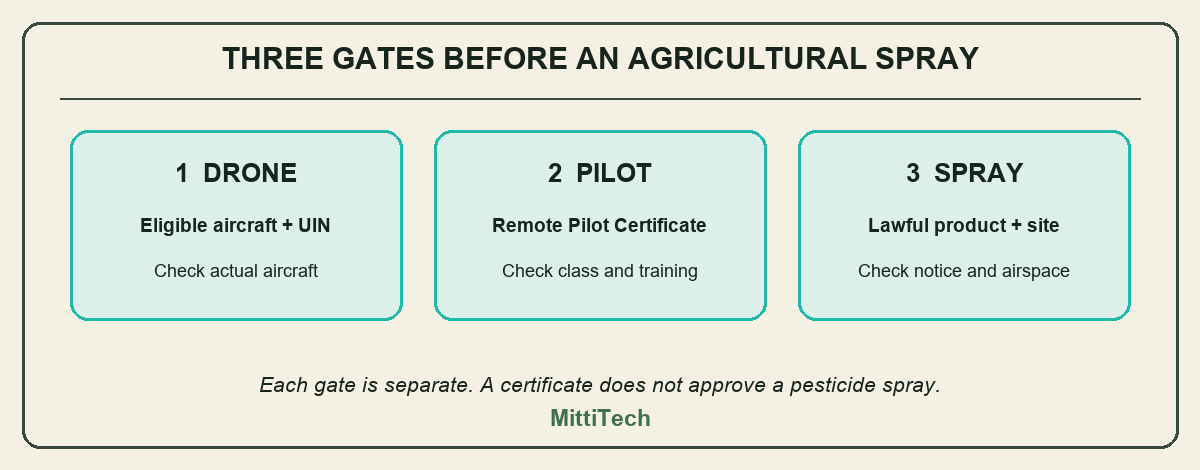
Passing one gate does not substitute for the others. A registered drone can still be flown by an uncertified operator. A certified pilot can still enter restricted airspace without permission. Both can be compliant on the aviation side and still apply a pesticide in a way that is not approved for that crop, pest, dose or delivery method.
First correction: India now calls it a Remote Pilot Certificate—not a licence
The original Drone Rules, 2021 used the term “remote pilot licence.” The Drone (Amendment) Rules, 2022 replaced that terminology with Remote Pilot Certificate and removed the separate DGCA licence step. Training and testing are conducted through a DGCA-authorised Remote Pilot Training Organisation (RPTO). For the current application route, use the DGCA’s eGCA entry point for drone users rather than assuming an older Digital Sky instruction still works.
People still say “drone pilot licence” in ordinary conversation, and many training advertisements use both terms. For a current document check, ask for the Remote Pilot Certificate.
Under the rules, an applicant generally must:
- be between 18 and 65 years of age;
- have passed Class 10 or an equivalent examination; and
- complete the prescribed training and proficiency test for the relevant drone category, sub-category and class at an authorised RPTO.
The certificate normally remains valid for ten years unless suspended or cancelled, subject to the applicable renewal and refresher requirements. A 2023 amendment also widened the identity documents accepted in the application: an Indian passport is no longer the only route; specified government-issued identity and address documents can be used.
Is anyone exempt from the pilot-certificate requirement?
The Drone Rules exempt a person operating a nano drone and a person operating a micro drone for non-commercial purposes.
That exception is easy to misuse. Paid crop spraying is a commercial activity, and a useful agricultural spraying drone—with its liquid payload—is normally not the sort of casual nano operation the exception was designed for. A farmer or service provider should not assume “small drone” means “no certificate.” Check the aircraft’s maximum all-up weight and the purpose of the flight against the current rules.
The drone itself needs its own compliance trail
With limited exceptions such as nano and model aircraft provisions, a drone must conform to a valid type certificate and be registered before operation. Registration generates a Unique Identification Number, or UIN, linked to the aircraft and key serial-numbered components. The 2021 rules refer to Digital Sky, but the DGCA now provides an eGCA entry point for drone users; verify the current filing route there. Digital Sky remains the place to check the current airspace map. DGCA also currently says registration of non-type-certified unmanned aircraft is temporarily suspended until further notice; do not assume a commercial spraying drone can be registered through an exception.
For a farmer hiring a service, the useful question is not “Does the company own a drone?” It is:
Can the operator show the UIN and match it to the actual drone being brought to my field?
A brochure, subsidy sanction, GST invoice or manufacturer’s claim is not a replacement for operational registration. If a flight-control module or remote pilot station is replaced, the linked registration details also have to be updated within the prescribed period before the aircraft is operated.
The service provider should also be able to confirm appropriate third-party insurance. The Drone Rules apply the Motor Vehicles Act approach to third-party insurance for drones, with a limited nano-drone exception. Insurance does not make an unsafe operation acceptable, but its absence is a warning about the provider’s compliance discipline.
Green zone does not mean “no rules”
India’s drone airspace map divides locations into green, yellow and red zones.
- Green zone: prior airspace permission is generally not required within the conditions shown on the map.
- Yellow zone: permission from the relevant air-traffic-control authority is required.
- Red zone: operation requires permission from the Central Government.
The map can change. The operator is required to check the current Digital Sky airspace map before commencing an operation and keep within the permitted conditions. A field that looks remote may still sit near an airport, defence installation, international border, strategic site or temporarily restricted area.
This is why “we have sprayed in this village before” is not enough. The check is for the location and time of the present flight.
Even in a green zone, the operator still has to follow the Drone Rules, the Insecticides Rules where insecticides are used, approved product conditions, privacy and safety requirements, local restrictions and other applicable law. The Ministry of Agriculture’s national and crop-specific SOPs should guide the spray plan; they are not a substitute for binding rules or product approvals. Green means the airspace permission is simplified; it does not legalise an otherwise non-compliant spray.
The pesticide is a separate permission problem
This is the part most likely to be missed in a low-cost quote.
The Insecticides Rules, 1971 are a binding layer for aerial insecticide application. Rule 43 requires approved insecticides and formulations at approved concentrations and heights, site marking, operator-provided washing/decontamination and first-aid facilities, public notification at least 24 hours before an aerial operation through competent authorities, exclusion of uninvolved people and animals for the specified period, and specialised pilot training including the clinical effects of insecticides. Rules 41–42 also require commercial spray operators to maintain poisoning first-aid supplies and arrange worker safety training. These duties sit alongside aviation requirements; a pilot certificate does not replace them.
Separately, the Ministry of Agriculture and Farmers Welfare issued a national SOP for drone application of pesticides and nutrients in December 2021, followed by crop-specific pesticide-application SOPs in 2023. Those SOPs provide operating guidance; they do not replace the binding Insecticides Rules or product conditions. The Central Insecticides Board and Registration Committee (CIB&RC) considers approvals or label endorsements for pesticide use through drones.
The practical consequence is important:
A chemical being registered for use on a crop does not, by itself, prove that every dose, water volume or drone application of that chemical is approved.
CIB&RC meeting records show drone-use endorsements being considered for individual pesticide formulations and crop uses. Before spraying, the operator should verify the current label/leaflet or other official approval covering the relevant:
- product and formulation;
- crop and target pest or disease;
- dose and dilution/application volume;
- pre-harvest interval and other label restrictions; and
- drone application method, where a separate endorsement or condition applies.
A dealer saying “everyone uses it in drones” is not evidence. Nor is a successful spray video. Ask to see the label or official approval that the operator is relying on.
What a compliant field operation should include
The binding Insecticides Rules and approved product conditions set minimum duties for an insecticide spray. The national agriculture SOP also covers registration, pilot certification, airspace, insurance, weather, the operation plan, pre-flight and post-flight procedures, emergency handling and protection of people around the site. A responsible provider should be able to explain both the legal duties and the operating guidance in plain language.
Before take-off, expect the operator to address at least the following:
- Field and airspace: exact plot boundary, obstacles, power lines, nearby roads and houses, airspace zone and any required permission.
- People and animals: mark the area, arrange public notice at least 24 hours in advance through the competent authorities for aerial insecticide spraying, and keep uninvolved people and animals out for the specified period.
- Weather: wind, rain, heat and visibility suitable for controlled application without unacceptable drift.
- Product plan: crop, target problem, pesticide or nutrient, approved dose, water volume and area to be treated.
- Aircraft plan: battery condition, payload, nozzle and flow settings, flight path, height and speed suitable for the crop and approved application.
- Safety and emergencies: personal protective equipment, safe mixing/loading, operator-provided washing/decontamination and first aid, worker and pilot training, spill response, loss-of-control response and a plan for an interrupted flight.
- Records: who flew, which drone and product were used, where and when the operation occurred, and what area was covered.
The exact controls and distances depend on the binding rules, approved product conditions, applicable SOP, site and local direction. Treat a provider who cannot show an operation and advance-notice plan as a higher-risk choice, even if the price per acre is attractive.
Who needs to do what?
If you are a farmer hiring a spray
You normally do not need your own UIN or RPC because you are not owning or flying the service provider’s aircraft. Your practical responsibility is to provide accurate field and crop information, authorise access, disclose nearby hazards, confirm what is being applied and avoid asking the operator to breach safety or label conditions.
Ask for four items before the job:
- the drone’s UIN/registration evidence;
- the pilot’s current RPC for the relevant class;
- the exact product label or approval supporting this drone application; and
- the quote and operation record showing area, dose, date and accountable provider.
For an insecticide spray, also ask who will arrange the Rule 43 public notice through the competent authorities at least 24 hours in advance, mark the area, exclude bystanders and animals, and provide washing/decontamination and first-aid facilities. The provider should confirm that the pilot has the required specialised insecticide training.
For pricing and the ownership-versus-hiring decision, see Drone Spraying Service in India: What Farmers Pay Per Acre.
If you own the drone but hire a pilot
Hiring a certified pilot does not transfer every responsibility away from the owner or operator. The aircraft still needs the correct certification, registration, maintenance, insurance and records. The organisation controlling the operation should define who checks airspace, who selects and approves the product, who secures the site and who reports an incident.
This is where informal arrangements become dangerous: the seller assumes the pilot will handle compliance, the pilot assumes the farmer chose the chemical, and the farmer assumes the subsidy or invoice means everything is approved. Put the roles in writing.
For the real subsidy rates and out-of-pocket costs, see Agriculture Drone Subsidy in India: Who Gets It and How to Claim.
If you are an FPO, Custom Hiring Centre or rural entrepreneur
You are operating a service, not merely owning equipment. Before buying, confirm type certification and the current DGCA registration route; DGCA has temporarily suspended registration of non-type-certified aircraft. Build a repeatable compliance file for every aircraft and pilot, plus a job sheet for every field. At minimum, assign an accountable person for:
- UIN, type-certificate and component records;
- pilot certificates and training currency;
- maintenance, batteries and insurance;
- Digital Sky airspace/permission checks;
- Insecticides Rules, approved-product conditions and agriculture-SOP guidance;
- Rule 43 advance public notice, area marking, exclusion and first-aid/decontamination facilities;
- farmer consent, field safety and spray records; and
- incident and complaint handling.
The government has supported institutional demonstrations and service channels, but a demonstration is not proof that a local operating system is ready. Our review of the KVK programme found strong awareness numbers but no published conversion measure showing how many farmers could later book a repeat service. See KVK Drone Demonstrations: What 4.27 Lakh Participants Actually Received.
Seven red flags before you accept a drone-spraying quote
- “No licence is needed because this is agricultural land.” Agricultural use does not create a blanket aviation exemption.
- The operator shows only a training-centre receipt. Ask for the actual Remote Pilot Certificate and check the applicable drone class.
- The UIN cannot be matched to the aircraft. A number in a WhatsApp message is not enough.
- “Green zone means no permission and no paperwork.” It removes the ordinary prior-airspace permission requirement, not every other rule.
- The pesticide is chosen only by the input dealer. Demand the label/leaflet or official basis for the crop, pest, dose, concentration, height and drone method.
- There is no discussion of advance public notice, wind, bystanders, power lines or drift. An insecticide spray needs the Rule 43 notice and exclusion controls, not merely a quick flight plan.
- The provider will not give a job record or invoice. If crop damage, drift or an incident occurs, undocumented work becomes an ownership dispute.
A five-minute pre-spray checklist for a farmer
Use this before the drone arrives or before mixing begins:
- I have the provider’s legal name, phone number, quote and invoice terms.
- I have seen the pilot’s current Remote Pilot Certificate.
- I have seen the drone’s UIN and can match it to the aircraft.
- The provider has checked today’s Digital Sky airspace status for my field.
- The crop, pest/problem, product, formulation and dose are written down.
- The provider can show the label or official approval supporting this application method.
- For an insecticide spray, the provider has arranged public notice at least 24 hours ahead through competent authorities and will mark the area and exclude uninvolved people and animals.
- The provider has washing, decontamination and first-aid arrangements, and the pilot has specialised insecticide training.
- Weather, nearby people, animals, houses, roads, water bodies and power lines have been considered.
- We agree who supplies water/product, who bears responsibility for mixing and what happens if weather stops the job.
- I will receive a completion record stating the date, field, area, product, dose, drone and pilot.
If these checks feel excessive for a small plot, compare them with the downside: an unapproved chemical application, pesticide drift, crop injury, an uninsured crash or no evidence when responsibility is disputed.
What changed—and what may change next
As of this article’s 13 September 2026 regulatory check, the operative public framework remains the Drone Rules, 2021 read with the 2022 and 2023 amendments, alongside DGCA directions and the Insecticides Rules, 1971 for aerial insecticide spraying. The 2022 amendment changed “licence” to “certificate”; the 2023 amendment broadened acceptable identity/address documents for the pilot-certificate form. The DGCA now provides an eGCA entry point for drone users; check the current filing route there rather than treating the older Digital Sky references in the 2021 rules as portal instructions. Digital Sky remains the airspace-map check. DGCA currently says registration of non-type-certified aircraft is temporarily suspended.
The Ministry of Civil Aviation has also published a Draft Civil Drone (Promotion and Regulation) Bill, 2025. A draft is not the same as an enacted law. Do not let a training provider or seller use a proposed rule to override the current Digital Sky, DGCA or pesticide requirements. Recheck the official portals before acting because airspace, approved products, operating directions and the legal framework can change after publication.
The honest bottom line
India has made civil-drone operation easier, but agriculture spraying is not a permission-free shortcut. A lawful service needs a compliant aircraft, a properly certified pilot and a compliant operation—including the location, product, dose and safety plan.
For a farmer deciding whether to hire or own, compare acreage, expected annual use, local service availability and the full cost of aircraft, trained pilot, insurance, maintenance and compliance. Hiring may be the simpler route when use is occasional, but “hire” should not mean “stop checking.” The most useful proof is a four-part pack: UIN, Remote Pilot Certificate, product approval and job record—plus the required advance-notice and safety plan for an insecticide spray.
That paperwork does not guarantee spray efficacy or prevent crop injury. It does something more basic: it shows who is accountable, what was authorised and whether the service planned to operate inside the rules. A drone may finish the field quickly; compliance and careful field controls reduce avoidable legal and operational risk.
Sources
- Ministry of Civil Aviation — Drone Rules, 2021 and Gazette record
- Ministry of Civil Aviation — Drone (Amendment) Rules, 2022
- Ministry of Civil Aviation — Drone (Amendment) Rules, 2023
- DGCA — eGCA service portal for drone users
- DGCA — drone notices and current registration status
- DGCA — non-type-certified aircraft registration notice
- Insecticides Rules, 1971 — Directorate of Plant Protection, Quarantine & Storage, including rules 41–43
- PIB / Ministry of Agriculture — national SOP for drone pesticide and nutrient application
- PIB / Ministry of Agriculture — crop-specific pesticide-application SOPs
- PIB — historical Digital Sky registration and CIB&RC pesticide-approval context (2022)
- CIB&RC — example Registration Committee record of a product-specific drone-use endorsement
- Ministry of Civil Aviation — current rules catalogue
- Ministry of Civil Aviation — Draft Civil Drone (Promotion and Regulation) Bill, 2025
Regulatory note: This article is a practical explanation, not legal or agronomic advice. Verify the current Digital Sky airspace map, DGCA/eGCA services, Insecticides Rules, CIB&RC product approval/label, Ministry of Agriculture SOPs and applicable state/local directions before an operation.
