

TL;DR — the verdict: Two of the three things people mean by “AI outbreak alerts” already work in India today. Weather advisories are genuinely operational — IMD’s Gramin Krishi Mausam Sewa pushes district- and block-level forecasts and farm advisories to millions of farmers twice a week. Reactive pest help is live too — the National Pest Surveillance System (NPSS) lets you photograph a pest and get an AI-plus-expert diagnosis and the correct pesticide dose. What is not reliably here yet is the headline promise: a genuine predictive early-warning that says “an outbreak is coming to your field next week.” That part is still mostly pilot-stage. Use the weather advisories to plan and NPSS to react correctly — but don’t bet your season on an advance outbreak forecast for your specific plot.
First, what do “outbreak alerts” even mean?
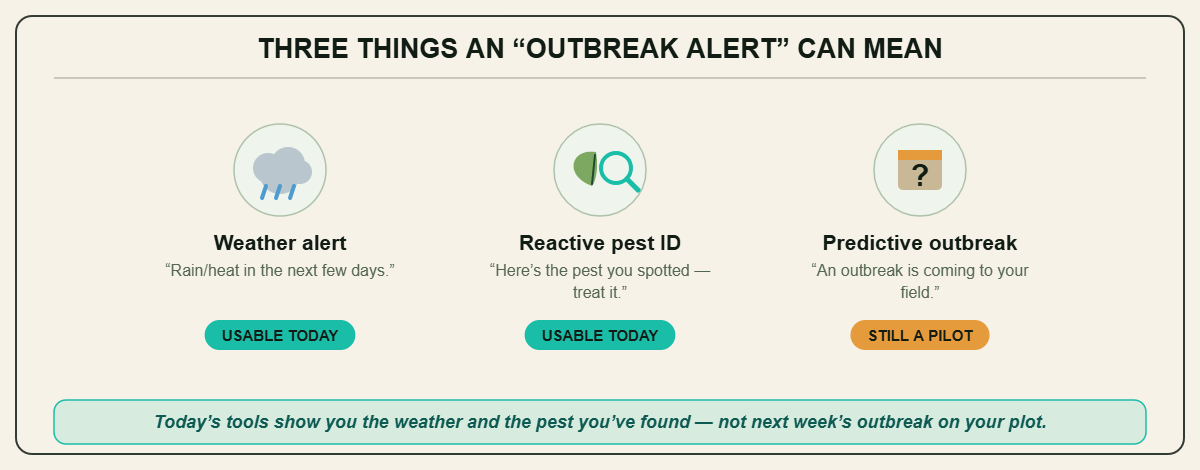
The phrase quietly bundles three very different things, and they’re at very different stages:
- A weather alert — “heavy rain / a heat spell is coming in the next few days.” This is forecasting, and India does it at scale.
- A reactive pest diagnosis — “here’s the pest you’ve already spotted, and here’s how to treat it.” This is recognition, and it’s now a national service.
- A predictive pest/disease outbreak warning — “conditions mean brown planthopper is likely to build up in your area over the next fortnight.” This is the hard one, and it’s largely still being piloted.
Keeping these three apart is the whole story — because the marketing tends to sell the third by pointing at the first two.
What’s genuinely usable today
1. Weather advisories — IMD’s Gramin Krishi Mausam Sewa (GKMS). This is the real, operational backbone. IMD generates medium-range (5-day) forecasts for rainfall, temperature, humidity, cloud cover and wind at district and block level, and a network of 130 Agromet Field Units (at agricultural universities and ICAR/IIT institutes) plus 199 District Agromet Units at Krishi Vigyan Kendras turns them into practical farm advisories every Tuesday and Friday. Under a public-private model, roughly 5.56 million farmers receive these forecasts and alerts. It’s not glamorous AI, but it’s the closest thing to a working “weather outbreak alert” a farmer can actually rely on. (Note the honest limits: it’s twice-weekly, medium-range guidance — not minute-by-minute nowcasting — and the KVK-level units have faced funding uncertainty, so coverage can vary by district.)
2. Reactive pest ID — the National Pest Surveillance System (NPSS). Launched by the Agriculture Ministry in August 2024 under the Digital Agriculture Mission, NPSS lets a farmer photograph an infested crop or insect on a mobile app or web portal; AI compares it against a large pest database, and scientists then confirm the diagnosis and recommend the right pesticide and dose. The explicit goal is to cut farmers’ dependence on whatever the input-shop dealer happens to be selling. It’s built to eventually reach a very large share of India’s farmers. This is genuinely useful — but notice it’s reactive: it helps once you’ve already seen the problem. It’s a cousin of the crop-disease apps we looked at earlier, and it carries the same photo-quality and field-reliability caveats.
3. State systems that stitch it together — e.g. Maharashtra. Maharashtra’s long-running Crop Pest Surveillance and Advisory Project (CROPSAP), now linked to the state’s MahaVISTAAR AI advisory app, runs structured field scouting plus advisories and has been credited with reducing how often pests cross damaging thresholds in cotton. Where a state actually resources the field surveillance, the “alert” becomes much more real. (If the name rings a bell, it’s the state-level sibling of the national voice service in our Bharat VISTAAR piece.)
What’s still pilot-stage
The genuinely predictive layer — warning you before a pest or disease builds up — is where reality lags the pitch:
- AI hyperlocal forecasting is still in trials. An AI-based system generated local monsoon-onset forecasts across parts of 13 states for Kharif 2025 to help time sowing — promising, but explicitly a pilot, not a guaranteed nationwide service.
- Outbreak prediction needs data India is still building. A trustworthy “outbreak is coming” model needs dense, real-time inputs — pest-trap counts, local ground observations, fine-grained weather — feeding it continuously. Those networks are thin and patchy, so predictions for a specific small plot remain unreliable, the same core problem we hit with AI yield prediction: models are far better at the region than at your field.
- Private “early-warning” apps vary widely. Many exist; few can show independently verified accuracy for advance outbreak calls in Indian conditions. Treat bold prediction claims with the scale question: predicted for a district, or for my field?
How to use what actually exists
- Get on the weather advisory. IMD’s GKMS advisories (via your KVK, the Meghdoot/Mausam apps, or SMS) are free and genuinely useful for timing sowing, irrigation and spraying around the coming weather. This is the highest-value, lowest-hype tool available.
- Use NPSS the moment you spot trouble. Photograph the pest and get a proper diagnosis and dose rather than guessing — or being sold — the wrong chemical. Take a clear, close, well-lit photo for a reliable read.
- Treat “outbreak predictions” as a heads-up, not a verdict. If a service claims to predict outbreaks, ask what scale it was validated at, then still confirm with your KVK before acting on anything expensive.
The honest bottom line
India has quietly built real, usable infrastructure for two-thirds of this problem: solid block-level weather advisories reaching millions, and a national system to correctly identify and treat a pest you’ve found. Those are worth using today. The third piece — a dependable, field-level warning that an outbreak is on its way before it arrives — is the genuinely hard, genuinely valuable part, and it’s still in the pilot phase. When someone sells you an “AI outbreak alert,” the useful question is simply: are you showing me tomorrow’s weather and yesterday’s pest, or are you really predicting next week’s outbreak on my plot? Today, mostly the former.
Sources
- IMD — Agromet Advisory Services / Gramin Krishi Mausam Sewa (PIB)
- IMD — Agricultural Meteorology Division
- IMD — Agromet advisory services overview
- National Pest Surveillance System (NPSS) — Plant Protection (PPQS)
- NPSS launch — Agriculture Ministry app for pest attacks (Deccan Herald)
- Maharashtra CROPSAP + MahaVISTAAR / AI in pest management (KPMG)
- AI monsoon-onset pilot across 13 states (Kharif 2025)
