
TL;DR
The bottom line: Bharat VISTAAR is a free government helpline that genuinely didn’t exist before — call 155261 from any phone, ask in your own language, and get crop, weather, mandi-price and scheme guidance, even without a smartphone. It’s the most farmer-aware piece of agri-tech India has shipped in a while. The catch: it’s only as good as the data behind it and the signal in your village, and it can’t see your specific field — so use it to get oriented, then confirm anything crop-critical with your local KVK. Worth a call today; don’t bet a whole season on it yet.
Bharat VISTAAR: what it is, in one line
Bharat VISTAAR is a multilingual, AI-based advisory system that lets a farmer ask agriculture questions by phone — voice call, chatbot, or (eventually) an app — and get an instant answer in their own language. Think of it as a digital krishi helpline where the person on the other end is an AI trained on government agricultural data.
The Ministry of Agriculture and Farmers’ Welfare launched Phase 1 in Jaipur on 17 February 2026, alongside the India AI Impact Summit, backed by a Rs 150 crore allocation in the Union Budget 2026–27.
A note on the name: the acronym VISTAAR is reported in some places as standing for “Village Information System for Technology-driven Agriculture and Rural reach.” Government materials mostly just use “Bharat VISTAAR” without consistently spelling out the full form, so treat the expansion as reported rather than official.
The one number that matters: 155261
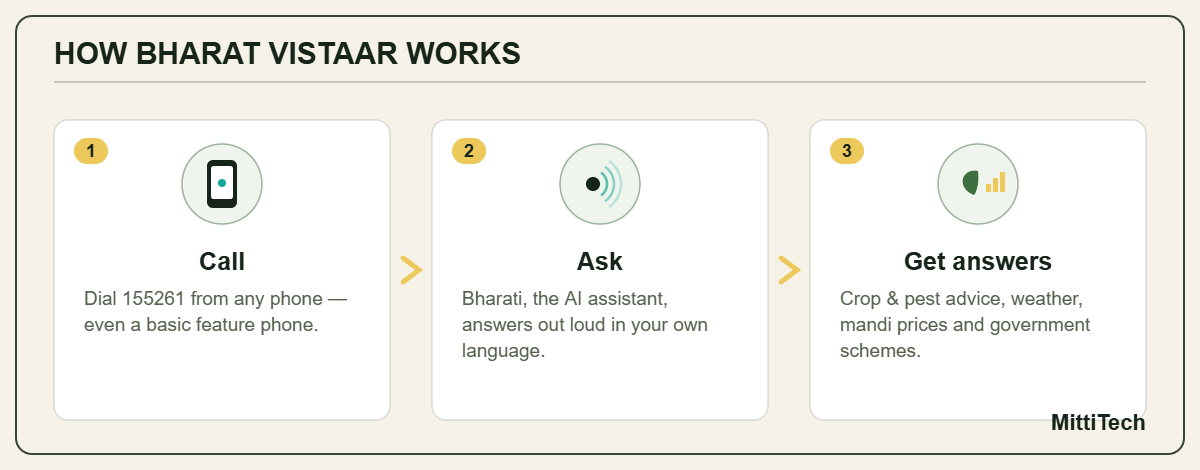
The single most important thing for a farmer to know is the helpline number: 155261.
You call it. An AI voice assistant named Bharati picks up and talks to you in plain language. You ask your question — “my tomato leaves are curling,” “what’s today’s onion rate in the nearest mandi,” “am I eligible for the next PM-KISAN instalment” — and it answers.
The deliberate design choice here is that it’s voice-first. You do not need a smartphone, an app, an internet connection, or the ability to read and type. A Rs 500 feature phone and a phone signal are enough. In a country where a large share of farmers are older, have limited literacy, or don’t own a smartphone, this is the most sensible decision in the whole project — and the one most likely to actually reach people.
What languages it speaks
At launch (Phase 1): Hindi and English.
The stated rollout plan:
- Within ~3 months: Tamil, Bengali, Assamese, Kannada
- Within ~6 months: a total of 11 languages
That’s the promise. As of now, if your working language isn’t Hindi or English, the tool isn’t fully for you yet. Worth checking back rather than writing it off — but also worth being honest that “coming in three months” and “actually working well in your dialect” are two different things.
What you can actually ask it
According to the government, Bharat VISTAAR brings several services into one interface:
- Weather — forecasts drawn from the India Meteorological Department (IMD)
- Mandi prices — real-time market rates across India
- Crop and pest advice — guidance on diseases, crop management, seeds, fertilisers, irrigation, soil testing
- Scheme access — information on and links to government programmes
- Soil health — tied to the Soil Health Card system
The data is meant to come from real sources: ICAR (Indian Council of Agricultural Research) for the agronomy knowledge, IMD for weather, and AgriStack for farmer records. That sourcing matters — it’s the difference between an AI guessing and an AI answering from official datasets. (How current and how local that data is, is the open question. More on that below.)
The schemes it connects you to
Bharat VISTAAR is positioned as a single doorway to ten major central schemes. The ones named in reporting include:
- PM-KISAN — Rs 6,000/year direct income support
- PMFBY (Pradhan Mantri Fasal Bima Yojana) — crop insurance
- Kisan Credit Card — credit access
- Soil Health Card
- Agriculture Infrastructure Fund
- PM Krishi Sinchayee Yojana — irrigation
- PM-AASHA — price support
- Modified Interest Subvention Scheme
- Per Drop More Crop — micro-irrigation
- Sub-Mission on Agricultural Mechanization
There’s also a digital Farmer ID (linked to AgriStack) meant to store your details so services like crop insurance and the Soil Health Card connect to you rather than making you re-enter everything each time.
If it works as described, the real value isn’t any single answer — it’s not having to chase ten different offices, websites and forms to find out what you’re owed and how to claim it.
The honest part: where it might fall short
This is a government launch, and launches describe the best case. Here’s what to keep your eyes open for, drawn from what analysts and the agriculture press have already flagged:
1. An AI answer is only as good as its data — and your field is specific. A national model trained on broad datasets can give you a sensible general answer. It cannot see your exact soil, your local pest pressure, or the variety you planted. Treat its advice as a well-informed starting point, not a verdict. For anything that could cost you a crop — a pesticide dose, a sowing decision, an irrigation change — confirm with your local KVK (Krishi Vigyan Kendra) or agriculture officer before acting.
2. Coverage is not the same as access. Roughly 80%+ of Indian farmers are small or marginal. Rural internet penetration is partial, and surveys suggest only about a quarter of farmers are genuinely comfortable using digital tools. The voice-first phone design is built precisely to get around this — but a voice helpline still needs a working phone signal, and a useful answer still needs the farmer to trust it. Elderly farmers, women farmers, and the poorest households face the steepest barriers, and those are often the people who’d benefit most.
3. Last-mile delivery has failed before. India has launched plenty of digital agriculture initiatives that looked good on paper and stalled at the village level — patchy connectivity, data that wasn’t kept current, schemes that existed in the system but not in practice. Bharat VISTAAR’s success depends on the unglamorous work of keeping data fresh and the line answering correctly, every day, for years.
4. Technology is a tool, not a cure. This is the bigger-picture caveat. Indian farm distress is driven by fragmented landholdings, weak rural infrastructure, market power, and uneven public investment. A good AI advisor can genuinely improve a farmer’s decisions. It cannot fix land insecurity or low prices. Useful — but let’s not oversell what an app can do.
So should a farmer use it?
Yes — with clear eyes.
It costs nothing to call 155261 and ask. For checking a mandi price, getting a weather heads-up, or figuring out which scheme you qualify for and how to apply, a free voice helpline in your own language is a real, practical convenience that didn’t exist before.
Where to be careful is acting on agronomic advice — disease treatment, chemical doses, big sowing or irrigation decisions. There, use Bharat VISTAAR to get oriented, then confirm with a human expert who can actually see your field.
The most encouraging thing about this project is the design instinct: voice-first, feature-phone-friendly, in regional languages, pulling from official data. That shows someone thought about the farmer who isn’t online. Whether the execution matches the intention is something we’ll only know over the next year — and it’s exactly the kind of thing this blog will keep checking back on. Curious how well AI handles the actual diagnosis side of farming? See our look at AI crop disease apps in Indian fields.
Sources
