

Registration opens an account. A sale needs a working market.
Yes, e-NAM can support an online agricultural sale. But registering does not itself find a buyer, establish your crop’s quality, arrange a truck or put money in your account.
The Ministry of Agriculture reported 1.89 crore registered farmers as of 30 June 2026, in a parliamentary reply published on 28 July. That supersedes the 1.80 crore figure reported for March. Neither figure tells us how many distinct farmers recently completed a sale. July parliamentary reply.
For a farmer, the useful question is: Can my crop, in my quantity and location, attract an acceptable bid—and can that sale be settled and delivered at a worthwhile net return?
What eNAM online trading actually changes
e-NAM links physical agricultural markets through an electronic trading system. It can make bidding and transaction records more transparent and widen buyer participation. A buyer can bid remotely while produce remains at its trading location; an online auction still needs a physical crop and an agreed handover.
The distinction matters when somebody describes the platform as a nationwide buyer waiting on your phone. National connectivity is an opportunity to reach buyers. Your particular lot still needs demand.
The July parliamentary reply reports average trader bids per lot rising from 2.1 in 2016–17 to 2.8 in 2025–26. It also reports 2,984.3 tonnes of interstate trade in 2025–26. These are separate measures: average bidding activity does not promise multiple bids on every lot, and interstate trade must not be confused with all transactions recorded on e-NAM. Ministry reply.
From account to sale: seven checkpoints
The official April 2026 backgrounder describes gate entry, lot identification, assaying, online bidding and electronic payment. The e-NAM directory adds weighment, invoicing and gate exit to the process. The checkpoints below translate that workflow into questions a first-time seller should ask; they are not a claim that we tested a transaction. PIB backgrounder; official directory, process flow.
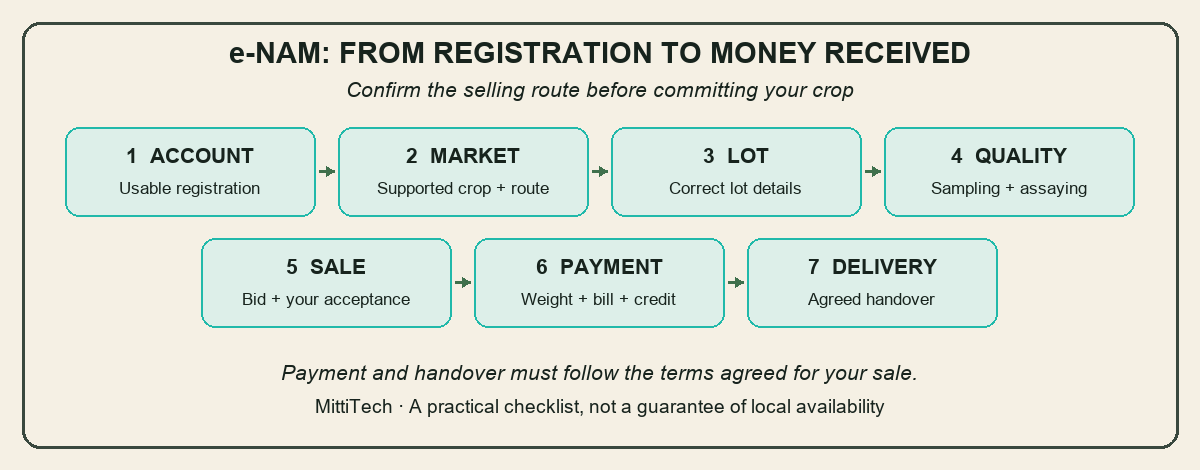
| Checkpoint | What you need to establish before relying on it |
|---|---|
| 1. Registration and support | Is your farmer account usable, and who will help with the first transaction? Start at the official portal or ask the market helpdesk. |
| 2. Market access | Does the intended location handle your commodity through e-NAM, on the day you plan to sell? Ask about arrival time, quantity and local requirements before loading. |
| 3. Lot creation | Which lot ID represents your produce? Check the commodity, quantity and description against what you brought or offered. |
| 4. Assaying | What quality parameters will be tested, who takes the sample, and can you see the result? Ask how a disputed result is handled. |
| 5. Bidding and acceptance | What offer has actually been made, on what terms, and how is your acceptance recorded? A displayed market price is not an offer for your lot. |
| 6. Weighment, invoice and payment | Does the final weight and sale bill match the agreement? Confirm the payable amount, deductions, bank details and expected payment route. |
| 7. Delivery and closure | Who arranges transport, pays loading and freight, and handles a delay or quality dispute? Keep the sale and handover records. |
ICAR-NAARM’s 2020 study describes seller acceptance or rejection of bids, followed by weighment and a sale receipt. It is useful process evidence, but its old payment timings and study findings should not be presented as a nationwide 2026 service guarantee. ICAR-NAARM study.
Assaying is where a distant buyer’s confidence begins
Assaying means assessing a sample against the relevant commodity’s quality parameters. For a buyer who cannot inspect the crop personally, the information attached to a lot becomes especially important.
Our practical recommendation is to inspect the quality result before accepting a sale. Ask whether the sample represents the whole lot, whether the recorded variety is correct, and what happens if the delivered crop differs from the recorded description. Do not mix lots with different quality and assume one result describes them all.
An assaying facility mentioned in a national programme is not confirmation that the equipment, staff and test you need are available at your chosen location that morning. Call ahead.
Do you always have to take the crop to a mandi?
There are several official routes. The 2021 e-NAM directory describes FPO collection-centre trading and an individual farmgate module, alongside warehouse-receipt trading. These establish that the platform’s design extends beyond a conventional mandi arrival. They do not establish that each route is operational for every farmer or location today. Official e-NAM directory.
| Possible route | Question to resolve locally |
|---|---|
| Physical market | Will this location create, assay and auction your commodity’s lot? |
| FPO collection centre | Is the FPO actually trading through this route? Confirm aggregation, quality, charges, payment distribution and collection arrangements. |
| Individual farmgate | Can the local team enable your account and commodity for this workflow? Who handles testing and pickup? |
| Warehouse / e-NWR | Can the warehouse and receipt be used for an e-NAM sale, and what are the storage and release costs? |
The April 2026 backgrounder confirms the e-NWR linkage. Ask for the arrangements applicable to the specific warehouse and commodity before paying to store produce. PIB warehouse section.
A higher bid can still leave you with less money
Use net proceeds, rather than the auction price alone, to compare routes.
Illustrative calculation—not a quoted market price: suppose you sell 20 quintals. A local offer of ₹2,200 per quintal gives ₹44,000 gross; after ₹1,000 in seller-borne costs, you retain ₹43,000. A distant offer of ₹2,300 gives ₹46,000 gross; after ₹4,000 in seller-borne costs, you retain ₹42,000.
The higher-priced option leaves ₹1,000 less in this example. Replace the assumed costs with your actual freight, handling, packaging, applicable deductions and other agreed charges. Only deduct expenses that you bear, and avoid counting a charge twice.
Payment delay, rejection exposure and perishability also matter even when they cannot be reduced to one dependable number. For a small perishable lot, a nearby dependable buyer may be more useful than a distant uncertain offer. Aggregation through an effective FPO may change that calculation; membership alone does not demonstrate an effective selling operation.
Payment: keep proof, and do not assume a universal deadline
Electronic settlement is part of e-NAM’s official design. Before accepting, ask which payment method is enabled for this sale and what happens if credit is delayed. Verify actual receipt through your bank and keep the lot ID, sale bill and payment reference.
The portal’s published challan guidance describes a minimum T+1 working-day timing for that particular payment route. That is not a promise for every e-NAM transaction. Avoid claims such as “all farmers are paid instantly” or “payment is guaranteed within 48 hours.” Official challan guidance.
Bihar: recorded trading is real, local readiness still matters
The Ministry’s February 2026 reply records Bihar trade volumes of 9 tonnes in 2022–23, 13.25 tonnes in 2023–24 and 3,307.73 tonnes in 2024–25. These are annual state-level quantities, not counts of farmers or proof of interstate sales. They demonstrate recorded activity; they cannot tell a farmer whether a particular crop can be sold at a particular location this week. State-wise parliamentary annexure.
For Bihar readers, the practical next step is to verify the intended market or FPO’s current commodity workflow. Ask when that commodity was last auctioned, who will create your lot and who will help settle the sale. Do not make a costly trip based only on a market name in a directory.
Before you load the crop: five questions
- Is this location currently conducting e-NAM sales for my commodity?
- Who will register or assist me, create the lot and provide the quality result?
- How do I see and accept an actual bid, and what deductions apply?
- When and how will I receive payment, and who handles a failed or delayed payment?
- Who collects the crop and bears freight, loading and any agreed rejection risk?
The official portal lists 1800 270 0224 for support. Use the official e-NAM website as the starting point for registration and access information. The portal and official releases describe web and mobile access; this guide does not claim a completed registration, a tested app or a first-hand sale. February 2026 Ministry reply.
Red Flag: An assured better price, nationwide pickup or fixed payment deadline offered without identifiable buyer, sale terms and local workflow evidence. Resolve those terms before committing produce or transport expense.
MittiTech’s assessment: e-NAM deserves consideration where a supported selling route, usable quality information, credible bids and clear settlement arrangements come together. Start with a manageable lot and retain the transaction evidence. Judge the result by money received after your costs, time taken and problems resolved.
For the wider digital-agriculture picture, read our AgriStack Farmer ID reality check. A farmer identity and a completed market sale are different outcomes.
