
TL;DR — the verdict: a free crop disease app is a genuinely useful second opinion, and far better than spraying whatever the shop hands you. But the headline “90%+ accuracy” comes from clean laboratory photos. On a real Indian field — dust on the leaf, harsh midday glare, two problems at once — independent tests put real-world accuracy closer to 70–85%, and the app states a wrong answer with exactly the same confidence as a right one. Use it as a first read, take a careful photo, and confirm anything that costs money — a pesticide, a fungicide — with your KVK or a local expert before you act.
What a crop disease app actually does
You photograph a sick leaf; an AI looks at the image and tells you what’s wrong — a fungal disease, a pest, a nutrient deficiency — and suggests what to do about it. The best-known example in India is Plantix, which says it can recognise around 800 symptoms across 60 crops, has been downloaded over 135 million times, and serves close to 10 million farmers a year in multiple Indian languages.
The problem they’re built to solve is real and worth naming. Today, when a crop looks sick, many farmers carry a leaf to the local input dealer — who often recommends whatever pesticide is on the shelf. That leads to unnecessary spraying, wasted money, and agrochemicals in the soil and water. An app that gives an independent, specific diagnosis is, in principle, a real step up from that.
Where the “90% accuracy” number comes from
Here’s the part the marketing doesn’t explain. Most of those impressive accuracy figures are measured on laboratory image datasets — the most common being PlantVillage, a set of about 54,000 photos covering 14 crops and 38 diseases. Those images are taken in controlled conditions: a single leaf, even lighting, a plain background. On that kind of clean data, models routinely score 95–99%.
A real field is nothing like that. Your photo has soil, weeds and other leaves in the frame; the light is uneven; the leaf may be dusty or wind-blown; and a plant often has more than one thing wrong with it at the same time. Researchers call this the “lab-to-field gap,” and it is well documented.
The honest field numbers
When the same kind of model is tested on real, uncontrolled photos instead of lab images, accuracy drops — in one frequently cited example, from about 99% in the lab to roughly 79% on real-world data (improving to the high-80s only after heavy optimisation). Reviews of these systems put real-field performance broadly in the 70–85% range, against 95–99% in the lab.
Plantix’s own field evaluation in Andhra Pradesh is refreshingly candid: in about one in five cases the app did not identify the disease correctly, and some problems — like certain peanut rots — simply aren’t well suited to diagnosis from a photo at all. The company is also clear that accuracy is affected by lighting, image sharpness, the crop, and where the symptoms sit on the plant.
(Treat the specific percentages as indicative, not precise: they come from different studies, crops and conditions, and your mileage will vary by what you’re growing and how good your photo is.)
What a photo can’t see
Two limits are worth keeping in mind. First, these apps can only diagnose what is visible on the surface — a root rot, a soil problem, or an early infection with no clear symptoms yet can be missed entirely. Second, the model is trained to pick the single most likely answer, so when a leaf shows two diseases, or a deficiency that mimics a disease, it can confidently give you one neat label that is only half the story.
The real risk: a confident wrong answer
The danger isn’t that the app is useless — it’s that it’s usually right, which makes the wrong answers easy to trust. If it misreads a nutrient deficiency as a fungal disease, you might spray a fungicide that does nothing, cost yourself money, and delay the real fix. Ironically, the very problem these apps were built to reduce — unnecessary spraying — can come back if a wrong diagnosis is acted on without a second check.
How to actually use one well
None of this means skip the app. It means use it like a sensible first opinion:
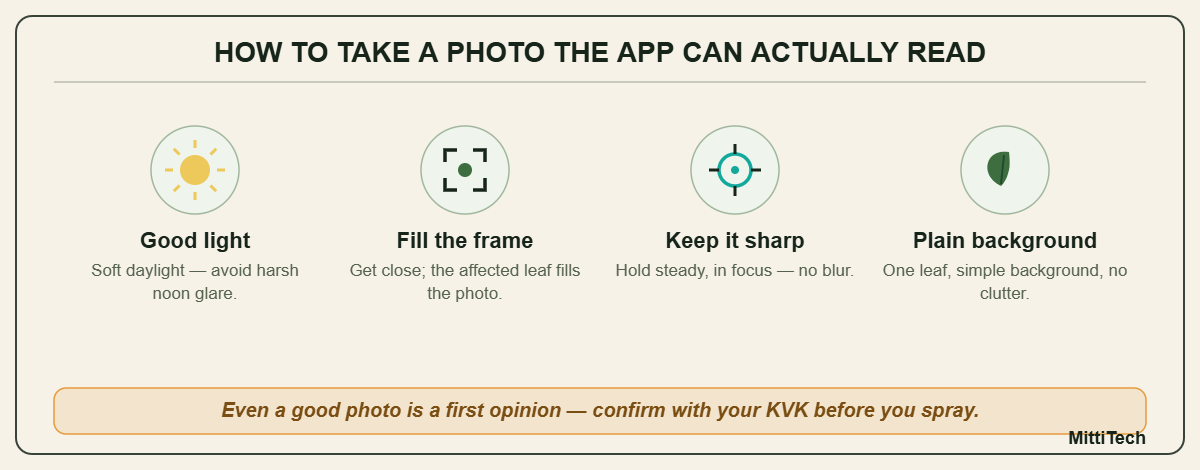
- Take a better photo than you think you need. Fill the frame with the affected part, in soft daylight (not harsh noon glare), in focus, with a plain-ish background. Image quality is the single biggest thing you control.
- Photograph more than one leaf and check whether the app gives the same answer — inconsistent results are a sign to be cautious.
- Treat the diagnosis as a lead, not a verdict. Before you spend money on any chemical, confirm with your local KVK (Krishi Vigyan Kendra) or agriculture officer — many will look at a photo on WhatsApp.
- Be most careful when the stakes are high — an expensive input, a large area, or a crop near harvest. That’s exactly when a wrong call hurts most.
So, are they worth using?
Yes — with clear eyes. For a free, instant, in-your-language second opinion that beats guessing or trusting the shelf at the input shop, a crop disease app is genuinely worth having on the phone. Just don’t mistake a confident screen for a certain diagnosis. The technology is good and getting better; the honest gap between the lab demo and your field is the part worth remembering before you reach for the sprayer. For another side of AI reaching Indian farmers, see our look at Bharat VISTAAR. For wider warning systems beyond a single-leaf diagnosis, see our guide to pest and weather outbreak alerts in India.
Sources
- GSMA — Detecting and managing crop pests and diseases with AI: Plantix
- Field study (Andhra Pradesh) — Automated plant disease diagnosis using the Plantix app
- Review of plant disease detection (lab vs field)
- PlantDoc — a field-image dataset (on PlantVillage’s lab limits)
- Bridging the lab-to-field gap in plant disease diagnosis
- Evaluating plant disease detection mobile apps — quality and limitations
