
TL;DR — the verdict: The agriculture drone subsidy is real, active, and generous on paper — 40–50% for individual farmers, 75% for FPOs, 80% for women’s self-help groups, 100% for KVKs. But two facts change the picture. First, the best rates go to groups and institutions, not individuals. Second, even at 50% off, a real spray drone still costs you ₹2.5–5 lakh out of pocket, plus a DGCA-approved machine and a pilot licence — and only about 2,122 drones reached individual farmers and hiring centres nationwide across roughly three years. For most small farmers the honest move isn’t to buy a subsidized drone; it’s to hire one at ₹150–300 an acre from a custom hiring centre or a Drone Didi. If you do want to own one, do it through an FPO or SHG, where the subsidy and the shared cost both actually work.
The headline agriculture drone subsidy rates (they’re real)
Under the central Sub-Mission on Agricultural Mechanization (SMAM), the agriculture drone subsidy rates by category are:
| Who you are | Subsidy | Cap |
|---|---|---|
| Individual farmer — SC/ST, small & marginal, women, or NE states | 50% | ₹5 lakh |
| Any other individual farmer | 40% | ₹4 lakh |
| FPOs & cooperatives | up to 75% | ₹7.5 lakh |
| Custom Hiring Centres / agri-entrepreneurs | 40% (higher under some provisions) | ₹4 lakh |
| Women’s Self-Help Groups (Namo Drone Didi) | 80% + free pilot training | ₹8 lakh |
| KVKs, ICAR institutes, agricultural universities (for demonstration) | 100% | ₹10 lakh |
Those numbers are genuine. The reality check is in who they’re really designed for.
The reality check: who actually gets them
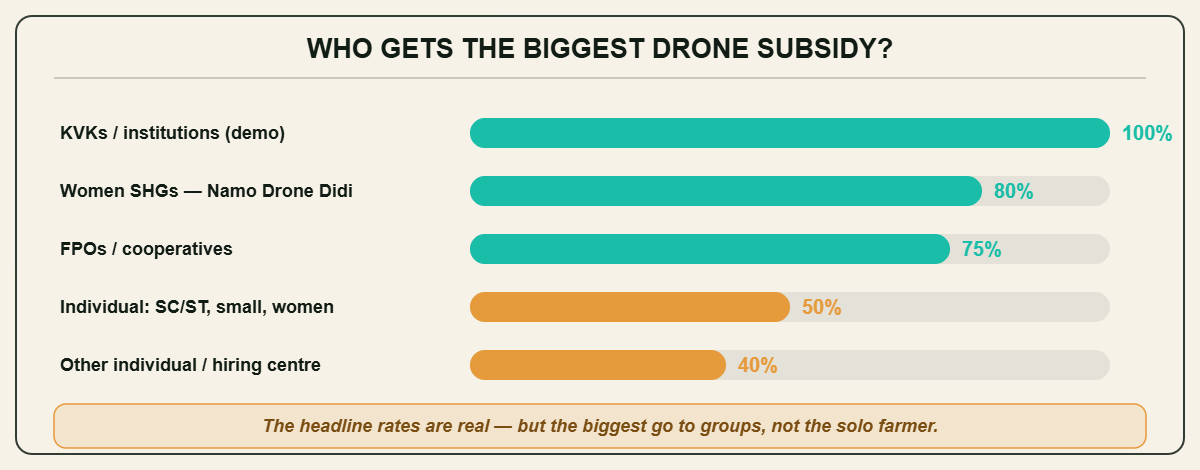
The scheme quietly favours groups over individuals. Look at the table again: the standout rates — 75%, 80%, 100% — all go to FPOs, women’s SHGs and institutions. An ordinary farmer buying a drone alone gets 40–50%, the lowest tier. That’s not an accident; the government’s real bet is on shared drones, not one per farm.
The volumes are small. Under SMAM, from 2023–24 up to 30 November 2025, around 2,122 drones in total were approved for distribution to individual farmers and custom hiring centres across the entire country. For a nation of over a hundred million farm households, that is a pilot-scale rollout, not a mass programme.
The out-of-pocket cost is still large. A usable spray drone runs about ₹4.5–7.5 lakh for a mid-range (20–30 litre) model, and ₹8–12 lakh for a heavy one. Even a 50% subsidy on a ₹6-lakh drone leaves ₹3 lakh for you to find — before training, batteries, repairs and insurance. For a farmer with a couple of acres, the maths rarely closes.
The requirements the ads skip
Getting the subsidy isn’t just filling a form. You also need:
- A DGCA-approved drone. Only a type-certified model from an approved manufacturer qualifies — you can’t subsidise just any drone.
- A Remote Pilot Certificate (RPC). Someone has to be a licensed drone pilot, trained at a DGCA-approved Remote Pilot Training Organisation. That’s time and money on top of the drone.
- A verified application trail. Aadhaar, PAN, land papers and a quotation from an approved vendor, all checked by your District Agriculture Officer before anything is released.
What about the states?
On top of the central scheme, states add their own layers — and this is where it gets patchy and hard to pin down. A few current examples: Telangana has offered a 40% state subsidy on agricultural drones; Maharashtra adds an extra ₹1 lakh for FPOs buying drones; Tamil Nadu provides free drone training for organic farmers. Most states, though, simply channel the central SMAM money plus occasional top-ups, and the specifics change year to year. There is no reliable, stable “state pays X%” table — so treat any such list you see as a starting point, and confirm the current position with your own state agriculture department. (An AI advisory line like Bharat VISTAAR is exactly the kind of place to ask what’s open in your district right now.)
How to actually claim it
If you’ve decided to go for it, here’s the real path:
- Register on the DBT portal. Go to the Central Agri Mechanization DBT Portal — agrimachinery.nic.in — and complete “Farmer Registration.”
- Pick a DGCA-approved drone and get a vendor quotation. The model must be type-certified; the vendor must be approved under the scheme.
- Apply and upload documents. Aadhaar, PAN, land records and the quotation. You’ll get an Application Reference ID to track it.
- Wait for verification. Your District Agriculture Officer reviews the application; on approval you’re notified by SMS/email.
- Sort the pilot licence. Line up a Remote Pilot Certificate through a DGCA-approved training organisation so the drone is legal to fly.
Should you buy — or just use one?
For most individual small and marginal farmers, the honest answer is: don’t buy — hire. Custom Hiring Centres and Namo Drone Didi groups get the drone heavily subsidised (up to 80%) precisely so they can spray your field on demand for roughly ₹150–300 per acre. You get the benefit of the technology without ₹3–5 lakh of capital, a pilot licence, or the maintenance headache. If you farm at real scale, or you can pool into an FPO or SHG, then buying — at 75–80% subsidy and shared across members — starts to make sense. Owning a subsidised drone as a lone smallholder almost never does.
The honest bottom line
The agriculture drone subsidy is not a scam and not vapourware — the rates are real and the portal works. But it was built for groups, institutions and service providers far more than for the individual farmer the headlines picture. Read it that way and it’s genuinely useful: join or use a shared service model and the technology becomes affordable today. Read it as “the government will buy me a drone at half price” and you’ll run into the cost, the paperwork and the pilot licence that the 50% number quietly leaves out.
Sources
- Govt promotes AI & drone technologies (PIB) — scheme status
- Dept. of Agriculture & Farmers Welfare — Mechanization Division (SMAM)
- Central Agri Mechanization DBT Portal (application)
- SMAM drone subsidy rates by category & how to apply (Marut Drones)
- Namo Drone Didi scheme (women SHGs, 80%)
- Telangana 40% state drone subsidy
- Agriculture spray drone prices in India (2025–26)
