
TL;DR — the verdict: AgriStack is no longer merely a government pilot. By March 2026, India had generated about 9.2 crore Farmer IDs, roughly 84% of the national target, while the Digital Crop Survey had covered 23.5 crore plots across 492 districts by Rabi 2024–25. Some states are already using this infrastructure for crop-loss payments and MSP procurement.
But the numbers need reading carefully. Creating an ID is not the same as delivering cheaper credit, better advice, faster insurance or improved market access. Those wider benefits remain uneven and poorly demonstrated at national scale. The system also works most naturally for farmers whose names and plots already match digital land records; tenants, sharecroppers and farmers with record errors remain the difficult part.
The honest conclusion: AgriStack has delivered the digital rails. The complete farmer service promised on top of those rails is still being built.
First, AgriStack is not one app
AgriStack is a digital infrastructure connecting three core registries:
- A Farmer Registry, which assigns each registered farmer a unique Farmer ID.
- A geo-referenced farmland registry, connecting farmers with mapped land parcels.
- A Crop Sown Registry, built through seasonal Digital Crop Surveys recording what is grown on each plot.
A fourth component, the Unified Farmer Service Interface, is intended to let authorised government departments, banks, insurers and agritech companies access relevant information—with consent—without repeatedly asking farmers for the same documents.
The promise is attractive: one verified identity that can make it easier to obtain credit, insurance, subsidies, crop advice and market services. The important question is how much of that promise is working today.
The scoreboard: promise versus delivery
| AgriStack promise | What has been delivered | Current verdict |
|---|---|---|
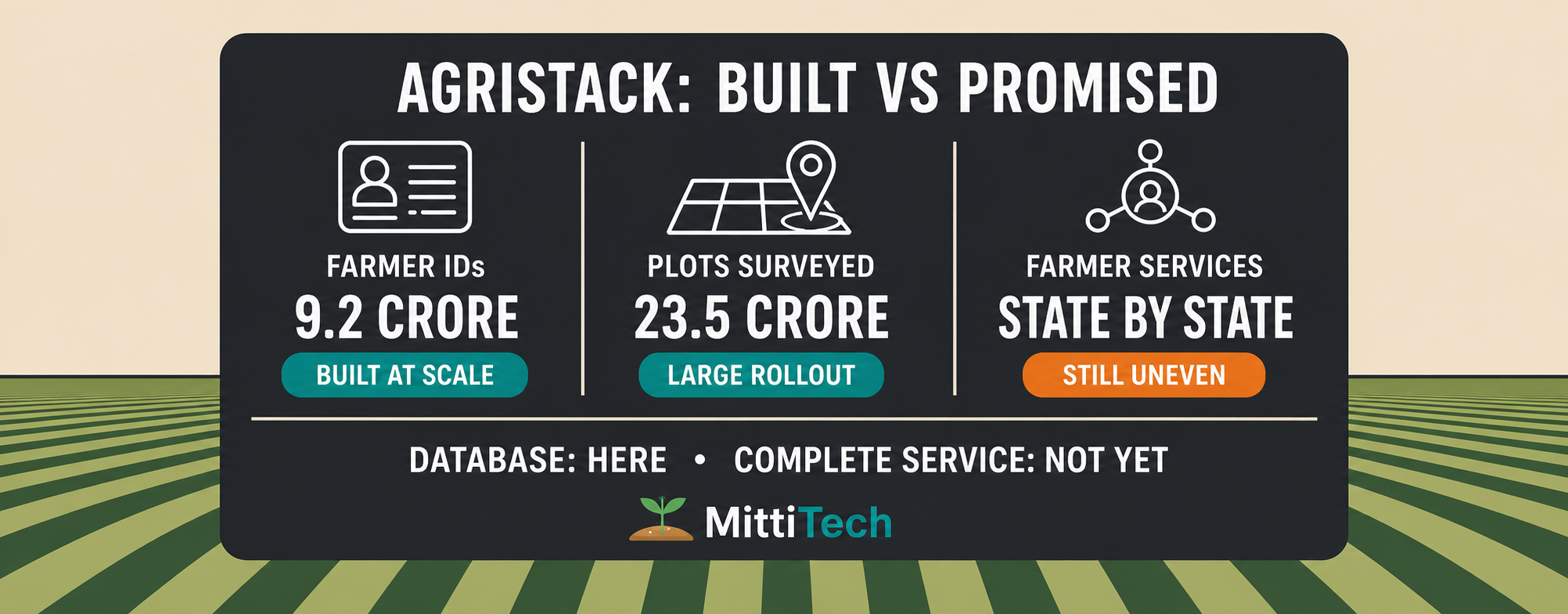
| A unique digital identity for every farmer | About 9.2 crore Farmer IDs by March 2026 | Large-scale and real, but not yet universal |
| A current map of crops on individual plots | 23.5 crore plot surveys across 492 districts in Rabi 2024–25 | Strong operational progress; nationwide completeness not yet demonstrated |
| Faster scheme and relief payments | Major examples in Maharashtra and Chhattisgarh | Proven in selected states, not consistently nationwide |
| Easier credit, insurance and personalised advice | Infrastructure and integrations are being developed | More promise than measured farmer-level outcome |
| Inclusion of tenants and sharecroppers | The software permits registration where states allow it | Technically possible, but dependent on state policy and documentation |
| Farmer control over data sharing | Consent-management architecture exists | Necessary progress, but governance and practical informed consent remain open questions |
What has clearly been delivered: the Farmer Registry
The government’s target is 11 crore Farmer IDs by 2026–27. By 19 March 2026, the official total had reached approximately 9.19 crore, or about 84% of that target.
This is not a small demonstration database. Uttar Pradesh alone had nearly two crore IDs, Maharashtra approximately 1.32 crore and Madhya Pradesh more than one crore. Bihar had around 47 lakh.
Each Farmer ID is intended to work as a permanent agriculture-specific identity linked dynamically with the farmer’s land records. In theory, a farmer applying for crop insurance or another service can authenticate themselves and have the relevant land information filled automatically instead of carrying physical documents between offices.
That basic identity layer is the part of AgriStack that has unquestionably moved from plan to national infrastructure. But an ID count measures registration—not usefulness. It does not tell us how many registered farmers obtained a loan, received better advice, corrected an insurance claim or saved a trip to an office because of it.
The second major delivery: Digital Crop Survey
The Digital Crop Survey replaces or supplements paper-based crop inspection with a smartphone-based, geo-tagged survey of individual plots.
Government data says the survey covered 461 districts during Kharif 2024. By Rabi 2024–25, coverage had risen to 492 districts and more than 23.5 crore surveyed plots.
This matters because governments have historically worked with crop-area information that can be slow, aggregated and occasionally inaccurate. Plot-level seasonal data could improve:
- Crop-production estimates.
- Insurance verification.
- Disaster assessment.
- Procurement planning.
- Input and fertiliser allocation.
- Localised crop advisories.
But “23.5 crore plots surveyed” does not mean 23.5 crore farmers received a new service. A farmer may have multiple plots, and a plot can be surveyed again in another season. The number demonstrates administrative reach—not direct household benefit.
Where AgriStack is already producing visible results
Two state examples show what the infrastructure can do when it is connected to a real programme.
In Maharashtra, the government says AgriStack-supported systems helped transfer more than ₹14,000 crore to 89 lakh farmers within five days for Kharif 2025 crop losses.
In Chhattisgarh, Farmer IDs and Digital Crop Survey data were used for MSP-based paddy procurement covering more than 32 lakh farmers in one season. The government credits the system with easier registration, crop verification and faster payments.
These are meaningful results. They show that AgriStack can reduce repeated paperwork and speed up a programme that already has funding and an administrative delivery mechanism.
They also reveal the present limitation: the strongest evidence comes from particular state programmes. National statements frequently say Farmer IDs “enable integration” with PM-KISAN, crop insurance, credit, input distribution and disaster relief. Enabling an integration is not the same as proving that each service works smoothly for farmers across every state.
The land-record problem
AgriStack’s great strength is also its biggest weakness: it links identity to digitised land records.
If the farmer’s name, Aadhaar details and land record match correctly, registration can become remarkably efficient. If they do not match, the digital system inherits the old record’s problem.
Common trouble points include:
- Different spellings across Aadhaar and revenue records.
- Inheritance or mutation records that have not been updated.
- Joint holdings.
- Missing or incorrectly mapped plots.
- An inactive Aadhaar-linked mobile number.
- Cultivation by someone other than the recorded owner.
The government has provided update and claim-verification processes, and farmers can receive help through camps, Common Service Centres, FPOs and local officials. Nevertheless, correcting a land record is a much larger task than filling out an online form.
A database does not repair an incorrect record merely by digitising it.
What about tenant farmers and sharecroppers?
Official documents say the Farmer Registry software has provisions for tenants, lessees and sharecroppers. But states decide whether and how to register them.
This distinction matters enormously. AgriStack’s first and easiest population is the landholding farmer because ownership can be checked against an existing revenue record. A tenant cultivating someone else’s plot may need a tenancy record, cultivation certificate or state-approved verification process—documents that are not always available in informal leasing arrangements.
The result is that “the system can include tenants” and “tenants are being included reliably” are not the same claim.
Until the government publishes clearer state-wise figures separating landowners, tenants, sharecroppers and other cultivators, inclusion should be treated as an unfinished part of the project.
The privacy question is real—but not one-sided
AgriStack can combine identity, land, crop, scheme and potentially financial-service information. The Digital Crop Survey application’s privacy policy lists information including a farmer’s name, mobile number, address, gender, caste, plot details, geo-location, IP address and device identifiers.
That combination can improve targeting and reduce fraud. It is also sensitive.
The official design uses a federated structure in which states retain ownership of registry data. AgriStack also has a consent-management mechanism intended to let farmers approve data sharing with government bodies, financial institutions and private service providers.
Those safeguards are important. But meaningful consent is difficult when the farmer does not fully understand what data is being shared—or when registration becomes practically necessary for receiving a benefit.
Independent data-governance researchers have therefore called for stronger purpose limitations, transparent access rules, audit mechanisms, grievance systems and rights over both personal and farm-generated data. A consent button by itself cannot answer every question about how a nationwide agricultural database should be governed.
What should a farmer do today?
If your state is using Farmer ID for a scheme, procurement or relief programme, registration is becoming practically important.
Before registering:
- Check that your name matches across Aadhaar and land records.
- Confirm that your current mobile number is linked with Aadhaar.
- Keep the correct khasra, survey number, khatauni, 7/12 or equivalent state land document available.
- Check every linked plot after registration.
- Keep the application or Farmer ID number safely.
- Use a government camp, Common Service Centre or agriculture office if the portal shows a mismatch.
Most importantly, do not assume that a Farmer ID changes legal land ownership. The registry is intended for identification, planning, advisory and service delivery; the underlying state revenue records remain the legal source.
The honest bottom line
AgriStack has delivered more than its critics sometimes acknowledge and less than its biggest promises imply.
The infrastructure is real: approximately 9.2 crore Farmer IDs, hundreds of districts surveyed and large state programmes using the resulting data. This is far beyond the pilot stage.
But today’s AgriStack is still strongest as a government verification and targeting system. The farmer-facing vision—seamless credit, automatic insurance, genuinely local advice, easier markets and equal inclusion for tenants—has not yet been demonstrated nationwide.
So the verdict three years into operational rollout is:
The database has arrived. Some benefits have arrived with it. The complete digital service promised to every Indian farmer has not—yet.
Sources
- Government of India — AgriStack overview and architecture
- PIB — Farmer Registry crosses 9.2 crore Farmer IDs, March 2026
- PIB — Digital identities and Digital Crop Survey coverage, February 2025
- PIB — 7.63 crore Farmer IDs and 23.5 crore plots surveyed
- AgriStack — Farmer Registry administrative and technical clarifications
- AgriStack Digital Crop Survey privacy policy
- IT for Change — Data-governance framework for AgriStack
