
TL;DR: AI irrigation scheduling is not a magic pump switch. The useful systems combine calibrated soil sensors, crop and weather data, and a decision model that recommends when and how much to irrigate. Australia, Europe and the United States already have field-tested or commercial examples. India now has credible ICAR pilots and reported water savings—but reliable, affordable service at small-farm scale is still the missing layer.
AI irrigation scheduling sounds futuristic, but its job is practical: replace “water every three days” with “water this field when the crop is likely to need it, in the quantity the root zone can use.” That difference matters in India, where the wrong irrigation can waste water, electricity and fertiliser—or stress the crop despite the pump running longer.
The interesting global shift is not the soil-moisture sensor by itself. Farmers have used probes for years. The newer system connects many signals—soil moisture at different depths, local weather, rainfall forecasts, crop stage, evapotranspiration and sometimes canopy temperature—then turns them into a usable irrigation decision.
What AI irrigation scheduling actually does
A basic sensor controller follows a threshold: if soil moisture falls below a set number, turn irrigation on. A smarter decision-support system asks more questions:
- How much water is available in the crop’s active root zone?
- Is rain likely before the next irrigation window?
- How quickly is the crop using water at its present growth stage?
- Does one part of the field dry faster than another?
- Will a full irrigation cause drainage below the roots or runoff?
The output may be a dashboard recommendation, a phone alert, or an instruction to an automated valve. The most mature systems keep the farmer in control while making the timing and quantity less dependent on guesswork.
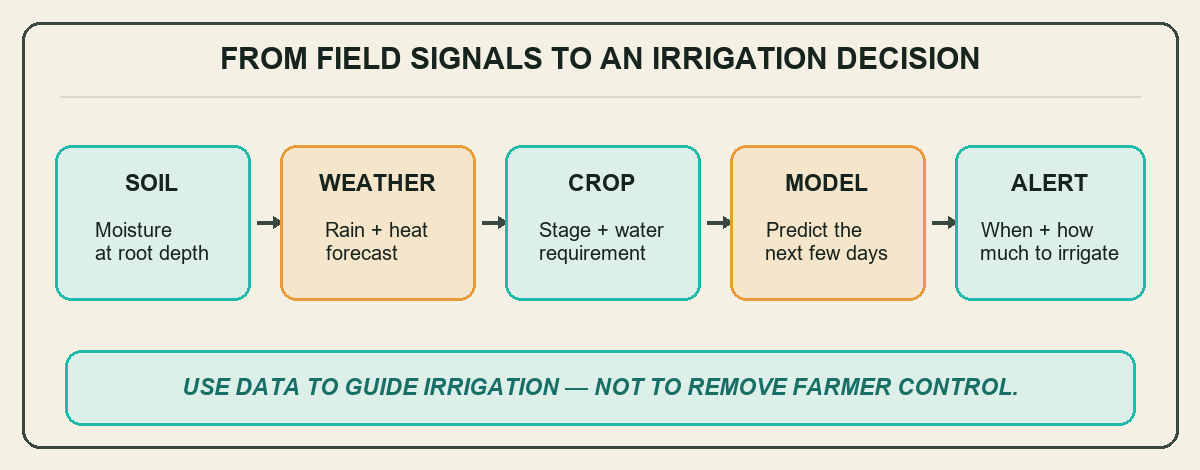
From a buried probe to an irrigation decision
- Field sensing: probes measure moisture or soil-water tension at one or more depths. Better systems use several locations rather than treating one point as the whole farm.
- Weather and crop context: rainfall, temperature, humidity, wind and solar radiation help estimate crop water use. Crop type and growth stage change the calculation.
- Connectivity: a low-power radio, mobile network or farm gateway moves readings to a dashboard. Some newer systems can make limited decisions locally when internet access fails.
- Prediction: a water-balance model or machine-learning layer estimates how the root zone will change over the next few days.
- Action: the system recommends a time and volume—or controls pumps and valves if the farm has compatible irrigation hardware.
This is why a ₹2,000 sensor and an AI irrigation service are not the same product. The service has to calibrate the probe, maintain communications, interpret the data and connect the advice to a real irrigation system.
What is already working abroad
Australia: plant stress plus soil moisture
Australia’s national science agency, CSIRO, developed WaterWise around continuous canopy-temperature sensing, soil-moisture measurements, weather forecasts and advanced analytics. Instead of waiting for visible wilting, the system tries to detect and forecast crop water stress. Its analytics have been taken to irrigators in Australia and the United States through a commercial sensing partner.
Italy: sensors, drones and AI in tomatoes
An EU CAP Network project in Italy combined ground sensors, drones and AI in tomato cultivation. The reported trial results included a 12.48% increase in marketable yield and a 12.05% reduction in waste, alongside real-time irrigation decision support. The important point is the combination: aerial observation showed spatial differences, while ground sensors tracked what was happening near the roots.
Flanders: forecasting the next ten days
A 2026 study indexed by FAO AGRIS tested a real-time decision system that combines sensor readings, a soil-water model and probabilistic weather forecasts to predict soil moisture for ten days. This moves irrigation management from “what is the moisture now?” to “what is likely to happen if I irrigate—or wait?”
United States: useful only after calibration
USDA Agricultural Research Service researchers showed that wireless sensors installed at several root-zone depths could support remote irrigation scheduling using soil-specific thresholds. But another USDA evaluation found that factory settings were unreliable in soils with higher salinity and clay content. That warning is crucial for India: a sensor that works in one soil cannot simply be copied to another field without calibration.
India is closer than it looks—but still pilot-stage
On 27 May 2026, ICAR-RCER in Patna inaugurated an indigenous IoT-enabled soil-monitoring system developed with BIT Mesra’s Patna campus. It is designed to guide irrigation with real-time field data. ICAR explicitly describes the deployment as a first phase, with calibration and field-performance evaluation still underway.
Other ICAR work shows that the idea is technically credible. Its landmark technologies summary reports 10–15% water savings from an IoT-enabled soil-moisture irrigation scheduler. It also reports a sensor-based micro-irrigation schedule in banana that saved 20% water while improving yield by 15%, and a subsurface-drip schedule for a maize-based system that saved 16% water and produced 12% higher yield than surface drip.
These are meaningful results, but they do not mean an average farmer can order a dependable AI irrigation service in every district today. The technology exists in Indian research farms and selected deployments; the repeatable delivery model is still forming.
Why it is not yet plug-and-play for Indian farms
- Calibration is local: soil texture, salinity, installation depth and crop roots affect readings. A generic threshold can create false confidence.
- Small, fragmented plots change the economics: a network needs enough sensors to represent field variation. One probe may be affordable but misleading; many probes raise the cost.
- Connectivity and maintenance matter: batteries fail, cables are damaged, gateways lose signal and sensors drift. A dashboard is useful only when someone owns the upkeep.
- The irrigation hardware must respond: precise advice has limited value if water arrives through an inflexible canal rotation or an uneven flood-irrigation layout.
- Farmers need a service, not a graph: the final recommendation must be understandable, crop-specific and backed by someone accountable when readings look wrong.
The same service-model lesson appeared in our article on pay-per-use drone spraying: expensive technology reaches smaller farms faster when an operator or FPO owns the equipment and sells a reliable outcome.
Where AI irrigation scheduling may become practical first
The earliest Indian fit is likely to be high-value horticulture, protected cultivation, orchards and farms already using drip or sprinkler systems. These operations can act on precise timing and often have enough value per acre to justify sensors and support.
A second route is shared infrastructure. An FPO, irrigation cooperative, agri-service centre or large buyer could operate the gateway, calibration and agronomy layer across many farms. Farmers would pay for a scheduling service rather than buying and maintaining a complete sensor network individually.
Remote sensing can widen coverage, but it should complement ground measurements. As explained in our guide to multispectral and thermal drone cameras, an image can show spatial patterns while a ground sensor helps explain what is happening in the root zone. Combining the two is more useful than expecting either one to be perfect.
Five questions to ask before paying for a system
- How will the sensors be calibrated for my soil and crop?
- How many sensing points and depths are included—and what field area do they represent?
- Does the recommendation include weather forecasts and crop stage, or only a moisture threshold?
- Who replaces failed sensors, batteries or gateways, and how quickly?
- Can the system show its recommendation in a simple local-language alert, and can the farmer override it?
Do not automate a pump solely from an untested sensor reading. Validate the system against field observations and qualified agronomic guidance before allowing unattended irrigation.
MittiTech verdict
AI irrigation scheduling is real, but the sensor is the easy part. The difficult product is a dependable local service that combines calibrated field data, weather, crop knowledge, working irrigation hardware and human support.
Abroad, that complete stack is moving from research into commercial use. In India, ICAR’s recent deployments show that the technical foundation is arriving. The breakthrough for small farms will come when FPOs and service providers package it as a per-acre or seasonal service—with maintenance and agronomic accountability included.
Sources
- ICAR-RCER: IoT-enabled Soil Monitoring System established in Patna, 27 May 2026
- ICAR: Landmark technologies in sensor-based irrigation scheduling
- CSIRO WaterWise: plant and soil sensing for irrigation decisions
- EU CAP Network: aerial and ground sensors for tomato irrigation
- FAO AGRIS: probabilistic soil-moisture forecasting and irrigation scheduling in Flanders
- USDA ARS: irrigation scheduling using wireless soil sensors
- USDA ARS: soil salinity and clay can undermine factory sensor calibration
