

A farm drone can cost several lakh rupees, needs a trained operator, and may sit idle for most of the year. For a small or marginal farmer, that makes ownership difficult to justify. A drone spraying service changes the calculation: book the machine only when the crop needs spraying, pay by acre or by operation, and leave the pilot, maintenance and battery logistics to the provider.
TL;DR: Pay-per-use drone spraying is usually the sensible route for a small farm, but only when neighbouring plots are grouped and the quote is clear. Treat ₹200–₹400 per acre as examples—not a guaranteed national tariff—and confirm the operator, approved chemical, minimum-area charge and respray policy before booking.
What “pay per use” actually includes
In a proper custom-hiring job, the farmer is not renting a drone to fly alone. The service provider brings the agricultural drone, batteries, spray system and trained operator, plans the flight, mixes or loads the approved input as agreed, sprays the field and removes the equipment.
The provider may be a Custom Hiring Centre (CHC), Farmer Producer Organisation (FPO), cooperative, rural entrepreneur, agri-input company, start-up or a women’s Self-Help Group operating under the Namo Drone Didi model. The government’s mechanisation programme supports these service channels specifically so farmers can access machinery without buying it.
Drone spraying cost per acre: the honest answer
India does not have one official nationwide retail price for drone spraying. The amount depends on the crop, field size, distance from the operator, terrain, chemical, water availability and whether enough nearby farmers book together.
There are useful real-world reference points. An ICAR profile of a Drone Didi serving villages in Ayodhya reports a charge of about ₹400 per acre. An ICAR article on nano-fertiliser application cites a spray cost around ₹200–₹250 per acre. These are examples from specific service models, not a promise that every farmer will receive the same price.
| What changes the quote | Why it matters |
|---|---|
| Total area booked | A provider can spread travel, setup and battery costs across more acres. |
| Scattered or irregular plots | More movement and flight planning can raise the effective per-acre cost. |
| Crop height and canopy | Tall or dense crops may need slower, more careful coverage. |
| Distance from service base | A travel or minimum-callout charge may apply. |
| Input and spray volume | The farmer may supply the chemical, or the quote may bundle it. |
| Repeat visit | A second application is a separate job unless the quote says otherwise. |
Do not compare only the headline per-acre figure. Ask for the total payable amount, including travel, GST if applicable, minimum acreage, chemical cost and any charge for water or field preparation.
Ownership versus hiring for a small farm
| Question | Own a drone | Hire the service |
|---|---|---|
| Upfront cost | Several lakh rupees even after subsidy | No equipment purchase |
| Pilot and compliance | Owner must arrange them | Provider should supply them |
| Maintenance and batteries | Owner’s responsibility | Provider’s responsibility |
| Useful for | Large acreage or a service business | Occasional spraying on small holdings |
| Main risk | Expensive machine remains under-used | Operator may not be available at the exact crop window |
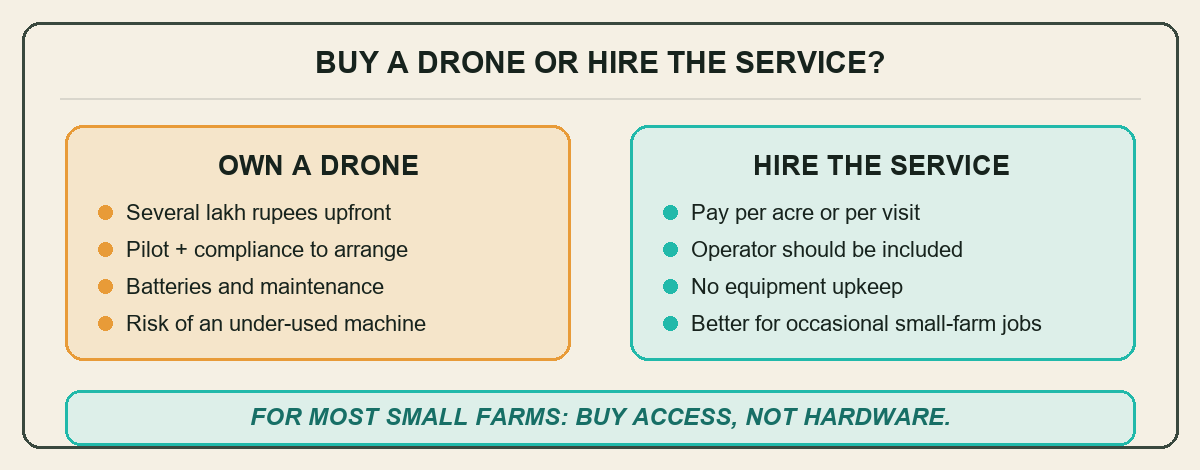
A purchase subsidy reduces the acquisition price; it does not remove repair costs, pilot availability, insurance, batteries or the need to keep the machine busy. Our earlier guide explains the agriculture drone subsidy rules in India. For a farmer with one or two hectares, the business case normally favours hiring unless the drone will also earn revenue by serving other farms.
Where can a farmer book a drone spraying service?
- Ask the local FPO, PACS or cooperative. These organisations are eligible to establish custom-hiring services and may aggregate bookings.
- Check the district agriculture office or state farm-mechanisation portal. Availability and application processes differ by state.
- Contact the nearest KVK. A Krishi Vigyan Kendra may know trained operators, recent demonstrations and approved local service providers.
- Ask SHG or Cluster Level Federation offices about a Drone Didi. The scheme equips selected women’s groups to provide rental services.
- Compare private operators. Drone manufacturers, fertiliser companies, agri-input dealers and start-ups may run booking networks, but the same safety checks still apply.
The strongest booking model is a village cluster. If five or ten neighbouring farmers coordinate the same spray window, the operator covers more acres in one visit and each farmer has a better chance of avoiding a high minimum-callout charge.
Seven questions to ask before paying
- Is the quote per acre, per hectare, per tank or per visit?
- What is the minimum billable area? A one-acre farm may still be billed for a larger minimum.
- Are travel, GST, water and the chemical included?
- Who is the trained remote pilot, and is the drone operated under the applicable Drone Rules?
- Is this pesticide or nutrient approved and suitable for drone application on this crop?
- What weather conditions will cancel the job? Wind or rain can make an application unsafe or ineffective.
- What happens if coverage is visibly missed? Get the respray or complaint policy before the flight.
Also walk the field boundary with the operator. Point out power lines, trees, people, animals, beehives, water bodies and neighbouring sensitive crops. Do not treat the drone as a shortcut around label instructions or agronomic advice.
When drone spraying makes the most sense
- The crop is tall, dense or difficult to enter safely.
- Labour is unavailable during a narrow pest or nutrient-application window.
- The field is wet and walking or tractor entry would damage the crop.
- Several nearby farmers can combine bookings.
- The task is a spray application—not a promise that an expensive camera will automatically diagnose the crop.
If a provider is selling mapping or crop-health analysis rather than spraying, ask what sensor is being used and who will interpret the data. Our plain-language guide to multispectral, thermal and hyperspectral drone cameras explains why the camera and the analysis matter more than the drone body.
When it may not be worth it
- A very small isolated plot attracts a large travel or minimum charge.
- The field is next to obstacles or a restricted flight area and cannot be operated safely.
- The recommended spray needs a water volume or droplet coverage the offered setup cannot deliver.
- The operator cannot show what product, dose, crop and application method will be used.
- The service is offered too late for the crop’s actual treatment window.
What the government schemes do—and do not do
Under the Sub-Mission on Agricultural Mechanization, eligible Custom Hiring Centres run by cooperatives, FPOs and rural entrepreneurs can receive assistance for buying drones so they can provide rental services. Agriculture graduates establishing CHCs receive a higher assistance ceiling. FPOs also receive support for demonstrations.
The Namo Drone Didi scheme supports selected women’s SHGs with drone packages for providing paid agricultural services. This expands the local service network; it does not mean every farmer automatically receives a free spray. The farmer still needs to ask the local provider about the applicable charge, booking rules and availability.
Government information reported that 2,122 drones were approved for individual farmers and CHCs during 2023–24 to 2025–26 as of 30 November 2025, while drone demonstrations reached more than 4.5 lakh farmers. The network is growing, but a demonstration in a district is not the same as a dependable commercial service in every village.
Verdict: buy access, not hardware
For most small and marginal farmers, the important question is not “Can I get a subsidy to buy a drone?” It is “Can I get a safe, timely spray at a transparent total cost?” Pay-per-use service answers that question better—especially when farmers aggregate acreage through an FPO, cooperative, CHC or SHG.
Start with one well-defined operation, record the crop, product, date, area and total charge, and compare the result with the farm’s usual spraying method. If the provider is reliable and the economics work, repeat. If the quote is vague or the operator cannot answer the safety questions, the drone’s speed is not a reason to proceed.
Sources
- Government of India: SMAM Operational Guidelines 2024
- Ministry of Agriculture: promotion of new technologies and drone deployment figures
- ICAR: Drone Didi of Ayodhya custom-hiring case
- ICAR Indian Farming: nano-fertiliser spraying costs and custom-hiring model
- Ministry of Agriculture: drone pesticide and nutrient application SOP
- Indian Journal of Agricultural Sciences: drone-assisted herbicide application economics
