
TL;DR: These three drone cameras all “see” colours your eye can’t — the difference is how many, and how finely. Multispectral catches a few extra bands and turns them into a crop-health map (the workhorse behind NDVI); it’s the one doing real work on Indian farms today. Thermal reads surface temperature — a “fever check” that’s genuinely useful for spotting water stress and irrigation problems, but it’s a specialist add-on. Hyperspectral splits light into hundreds of fine slices to read a plant’s chemical “fingerprint” — powerful in a lab, but heavy, very expensive and expert-only, so it’s research-stage, not something a farm uses. And the honest catch that applies to all three: the camera is the easy part — the value only appears if someone can read the map and you can act on it.
First, the one idea behind all three drone cameras
Your eyes see three bands of light — red, green, blue. Crops, though, leak information in wavelengths you can’t see, especially near-infrared, which healthy leaves reflect strongly. All three of these drone cameras are just different ways of capturing that invisible light. The more bands a camera captures — and the finer it slices them — the more you can learn, and the more it costs and the harder the data is to handle. That’s the whole trade-off. Multispectral, thermal and hyperspectral are just three points on that scale.
Multispectral — the workhorse
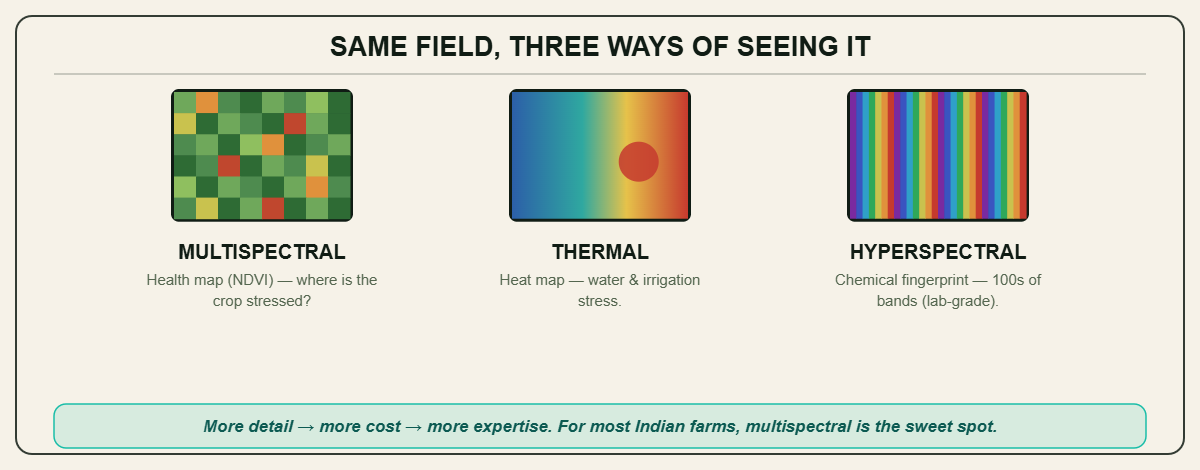
What it sees: a handful of specific bands — usually red, green, blue, near-infrared and “red-edge.” Software combines them into indices, the famous one being NDVI, which turns the invisible near-infrared signal into a simple health map: green where the crop is vigorous, red/orange where it’s stressed.
What it’s actually good for: spotting the weak patches in a field before you can see them with your eyes — often two to three weeks early — and then acting on them. That “act on them” part is the point: an NDVI map lets a spray drone do variable-rate application (more input only where it’s needed), and it feeds crop-monitoring and even yield estimates.
India reality: this is the sensor doing the real work. Small mapping drones with a multispectral camera start around ₹50,000, and most spraying/scouting services use one. If you only remember one of these three names, remember this one.
Thermal — the water specialist
What it sees: surface temperature — literally a heat map of the field. Stressed plants close their pores and stop cooling themselves, so they run hotter; a thermal camera catches that as a warm patch.
What it’s actually good for: water. It’s the best tool for finding irrigation problems — a blocked drip line, an under-watered corner, an over-watered dip — and for catching water stress early. It can hint at disease too, but that’s less reliable.
India reality: a useful add-on, most valuable on irrigation-heavy farms (horticulture, drip systems). It’s usually paired with multispectral rather than used alone, and for most small rain-fed plots it’s a nice-to-have, not a need.
Hyperspectral — the lab-grade fingerprint
What it sees: not a few bands but hundreds of ultra-fine slices of the spectrum. Where multispectral gives you a few colours, hyperspectral gives you a near-continuous chemical signature of the plant.
What it’s good for (in theory): detailed nutrient profiling and pinning down specific diseases by their spectral fingerprint — things the coarser cameras can only hint at.
India reality: this is where hype outruns the field. Hyperspectral sensors are heavy, cost many lakhs (₹12–20 lakh and up), and produce huge datasets that need specialists and serious computing to interpret. It’s a research and high-value-crop tool, not something an ordinary farm — or even most drone-service providers — will touch for years. Impressive, and mostly not for you yet.
Side by side
| Camera | What it captures | Best for | Where it stands in India |
|---|---|---|---|
| Multispectral | A few extra bands (NIR, red-edge) → NDVI health map | Finding stressed patches; variable-rate spraying; yield checks | The practical workhorse — most agri-drone mapping uses it |
| Thermal | Surface temperature — a heat map | Water stress; irrigation leaks and blockages | Useful add-on, mainly for irrigation-heavy farms |
| Hyperspectral | Hundreds of fine bands → a chemical fingerprint | Nutrient profiling; specific disease ID; research | Expensive, heavy, expert-only — research-stage, not for farms yet |
The bottleneck nobody sells you: reading the map
Here’s the part the sensor brochures skip. The camera is the easy part. The hard — and valuable — part is turning a colourful map into a correct decision. A beautiful NDVI image is worthless if no one can tell whether that red patch is drought, a nutrient gap, a pest, or just a shadow at the wrong time of day. Practitioners put it bluntly: many people fail at the interpretation step, so invest in the training and the agronomy, not just the hardware. The same honesty we applied to crop-disease apps applies here — the picture is only as good as the person reading it.
So what does a farmer actually need?
- You almost certainly won’t buy any of these cameras. You’ll get their output — usually a multispectral NDVI map — through a drone service, an FPO, or a state programme (often subsidised; see our drone subsidy reality check).
- Multispectral is the one that matters for almost everyone: it tells you where to look and act.
- Thermal earns its place if water and irrigation are your main levers.
- Hyperspectral is worth knowing the word — and, for now, little more.
- Whatever the camera, ask the provider the real question: who reads this map, and what will I actually do differently because of it?
The honest bottom line
“Multispectral, thermal, hyperspectral” sounds like three competing gadgets. It’s really a ladder of detail and cost. For Indian farming today, multispectral sits on the sweet spot — affordable, genuinely useful, and already in the field. Thermal is a targeted second tool for water. Hyperspectral is the powerful, pricey future. But none of them help unless the map turns into a decision — so the smartest money isn’t on the fanciest sensor, it’s on knowing what to do with the one you can already get.
Sources
- Agriculture drones in India — 2025 guide (multispectral/NDVI, variable rate, service models)
- Multispectral sensor drones in farming — bands, NDVI, uses (DroneZon)
- Agricultural drone images & camera price ranges 2026 (Farmonaut)
- NDVI drone mapping — indices, early stress detection (Farmonaut)
- Precision agriculture drone mapping — NDVI, variable rate (Aeroyantra)
