

TL;DR — the verdict: KVK drone demonstrations in India form a real, large-scale extension programme. The latest official return says ICAR institutions, Krishi Vigyan Kendras (KVKs) and State Agricultural Universities procured 297 drones, conducted 36,882 demonstrations, covered 38,280 hectares, and recorded 4,26,579 participating farmers by 15 March 2026. But “participated” mostly means a farmer attended or observed a demonstration—not that they learned to fly, received a drone, booked a service, or used one again. The programme has done the awareness job. The government has not published the conversion numbers needed to prove adoption. The missing measure is simple: after the drone left the field, how many farmers could actually hire one locally at a workable price?
First, correct the headline: it is 4.27 lakh—not a verified 4.5 lakh
The clean headline circulating around the programme is that roughly 4.5 lakh farmers were reached. The latest detailed government answer available by our cutoff gives a more exact figure: 4,26,579 farmers participated in drone demonstrations from 2022–23 to 2025–26, as of 15 March 2026.
That is still a serious extension effort. It just needs the right label. These are participants, not 4.27 lakh drone users or adopters.
The same Lok Sabha answer reports:
| Latest official return (15 March 2026) | Reported result |
|---|---|
| Drones procured by participating institutions | 297 |
| Drone demonstrations | 36,882 |
| Area covered | 38,280 hectares |
| Farmers who participated | 4,26,579 |
| Central funds provided to ICAR | ₹52.50 crore |
Across the programme, that averages about 11.6 participating farmers and 1.04 hectares per recorded demonstration. Those averages help explain what the exercise was designed to do: expose groups of farmers to a live application on a relatively small plot.
What a KVK drone demonstration actually looks like
A typical event is part live field operation, part awareness meeting.
The drone is brought to a farm or institutional field. Officials or scientists explain agricultural uses, safety, possible subsidies and the value of contactless spraying. The operator then flies the drone over a crop and demonstrates the application of a nutrient, fertiliser or approved crop-protection product. Farmers watch the flight, see the speed and coverage, and ask questions.
ICAR’s own event reports show the format clearly:
- An Ajmer programme in October 2022 briefed attendees on spraying, crop monitoring, soil-health assessment, financing and employment potential. Around 100 farmers, students, staff and media attended.
- A Goa programme in March 2026 demonstrated foliar nutrition in a community field and recorded 128 farmers, including farm women, as participants.
- Other ICAR-linked demonstrations have combined live spraying with briefings for farmers, FPO representatives, SHGs, Custom Hiring Centres and agriculture officials.
That is useful exposure. A farmer can see that the machine is not science fiction, compare it with manual spraying and understand where a service might save labour or reduce direct exposure to spray.
But watching a drone fly is not the same as becoming able to use one next week.
The programme nearly bought every planned drone—but covered only about half the planned area
The original rollout provided ₹52.50 crore to ICAR for 300 drones and demonstrations across 75,000 hectares, routed through 100 KVKs, 75 ICAR institutions and 25 State Agricultural Universities.
Against that plan, the March 2026 return shows:
- 297 of 300 drones procured — 99% of the asset target
- 38,280 of 75,000 hectares covered — about 51% of the planned area
So the hardware procurement was almost complete, while the reported field coverage was far behind the original scale. That does not make the programme a failure: demonstrations can be delayed by crop seasons, weather, trained-pilot availability, permissions, batteries, repairs and suitable local plots. But it does reveal a familiar implementation pattern—buying the equipment is easier than keeping it deployed across thousands of farms.
There is also an official numbers problem
The public record does not reconcile cleanly.
A Lok Sabha answer dated 16 December 2025 reported 40,928 demonstrations covering 40,918 hectares during 2023–24 to 2025–26. A later answer dated 20 March 2026, reporting data as of 15 March, gave the lower totals of 36,882 demonstrations and 38,280 hectares, despite using a period that began a year earlier.
The later return adds the farmer-participation number and a complete state table, so it is the best current basis for this article. But cumulative programme totals should not decrease without an explanation. The discrepancy may reflect data cleaning, a changed definition or a reporting error; the documents do not say which.
State figures also suggest that “demonstration” was not counted in one uniform way. The March table implies roughly:
- 2.1 farmers per demonstration in Bihar
- 23.6 in Haryana
- 61.4 in Jammu & Kashmir
- fewer than one farmer per demonstration in Jharkhand, which may mean repeated applications for the same farmer or plot
These are not necessarily false numbers. They show why raw national totals should not be treated as a consistent count of identical public events.
What the programme genuinely achieved
Three things deserve credit.
First, it put working machines in the extension network. A farmer is more likely to trust a technology seen operating in a nearby field than a manufacturer’s video.
Second, it made the service model visible. For most small and marginal farmers, buying a drone is not the sensible route. The practical model is a licensed operator serving many farms through an FPO, Custom Hiring Centre, rural enterprise or women’s SHG.
Third, it demonstrated a meaningful safety advantage: the operator does not have to walk through the crop carrying a pesticide tank. The precise agronomic result still depends on the product label, crop, canopy, weather, droplet size, flight settings and adherence to government SOPs. A fast spray is useful only when it is also the correct spray.
What 4.27 lakh “participants” does not tell us
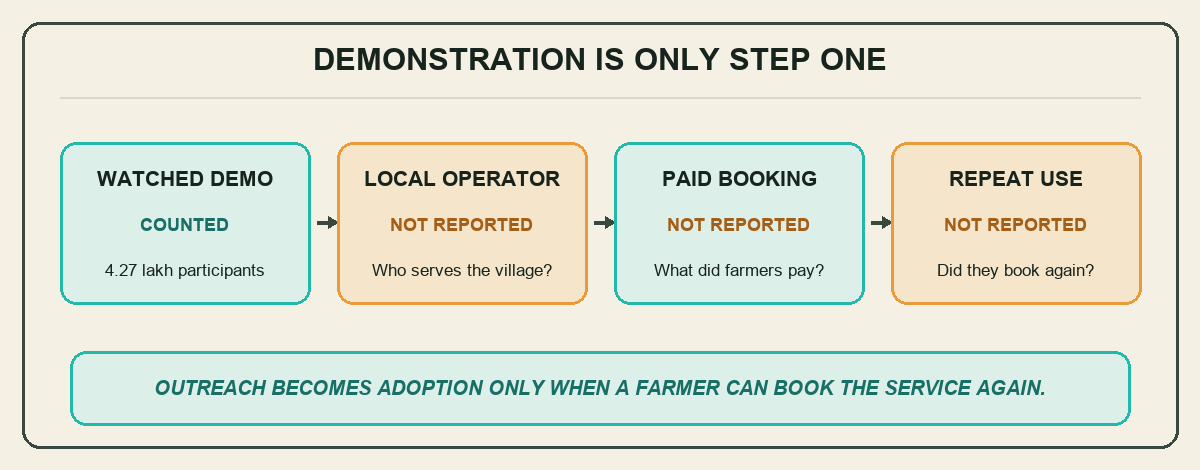
The published figures do not answer the questions that turn awareness into adoption:
- How many participating farmers later booked a drone spray?
- How many villages had an operator available during the actual spray window?
- What did farmers pay per acre after the demonstration?
- How many used the service for a second crop or season?
- Did the service reduce labour cost, water use or chemical exposure under real local conditions?
- How often were institutional drones operational rather than waiting for a pilot, battery, repair or suitable crop window?
Without those measures, 4,26,579 is an outreach number, not an adoption number.
This is the central weakness in the public reporting. The government counts the moment a farmer encounters the technology. It does not yet show whether the encounter becomes a reliable local service.
After the demonstration, where does a farmer get the drone?
Usually, not from the KVK.
The fully funded institutional drones were procured primarily for field demonstrations. Continuing commercial spraying is expected to come through separate channels:
- Custom Hiring Centres and rural entrepreneurs
- Farmer Producer Organisations and cooperatives
- Namo Drone Didi women’s SHGs
- private DGCA-compliant drone service providers
These channels have their own subsidy, training and business arrangements. See MittiTech’s guide to drone spraying services and per-acre costs and its agriculture drone subsidy reality check for the practical access routes. A good demonstration should therefore end with a local handoff: the operator’s name, crops served, price per acre, service radius, booking method and the dates when the drone will actually be available.
If that handoff is missing, the event creates interest without access.
Five questions a farmer should ask before leaving
- Who can spray my field locally? Get a real name and phone number, not only a scheme name.
- What is the complete price per acre? Confirm whether the quote includes travel, operator, batteries and water handling; the farm input itself may be separate.
- Which crops and products can the operator legally apply? Drone use does not override an approved product label or government SOP.
- Is the drone compliant and the pilot properly certified? The cheapest informal option is not worth a safety, crop-damage or regulatory problem.
- Can I book it during my actual spray window? A drone available next month is useless when pest pressure needs attention this week.
The honest bottom line
The KVK drone demonstration drive did what a demonstration programme is supposed to do: it took unfamiliar equipment into farmers’ fields and let lakhs of people see it work. That is real progress.
But the programme’s success should not be described as 4.27 lakh farmers “using” drones. The official wording is that they participated in demonstrations, and the distinction matters. Nearly all the planned drones were purchased, roughly half the originally planned area appears in the latest return, and the published totals themselves require reconciliation.
The next phase should be measured differently: not how many farmers stood near a drone, but how many could book a safe, affordable service afterward—and chose to use it again. A demonstration proves that the machine can fly. A local service proves that the programme landed.
Sources
- Lok Sabha Unstarred Question No. 4614, answered 20 March 2026 — latest programme totals and state table
- Lok Sabha Unstarred Question No. 2540, answered 16 December 2025 — earlier conflicting demonstration and area totals
- Earlier parliamentary answer — 300-drone and 75,000-hectare plan
- PIB: Drone Technology — institutional demonstration support and Custom Hiring Centre assistance
- PIB: Grant-in-aid structure for Kisan Drones
- ICAR: Drone demonstration for farmers at Ajmer
- ICAR: Agri-drone demonstration in Goa
- Indian Farming: Application of drone technology for sustainable agriculture in western India
Verification note: figures are reported as of 15 March 2026 and use 11 July 2026 as this article’s news cutoff. The December 2025 and March 2026 parliamentary totals conflict; the article uses the later, more detailed return and flags the discrepancy rather than guessing a reconciliation.
